
AI and Smart Energy Management in Off-Grid Solar Systems
AI and Smart Energy Management in Off-Grid Solar Systems
Off-grid solar systems are becoming easier to monitor and manage as charge controllers, sensors, communications devices, and remote-management platforms provide more information about solar production, batteries, loads, and operating conditions.
Artificial intelligence can add another layer by analyzing that information for patterns, forecasts, anomalies, and operating decisions. But it is important to distinguish genuine AI or machine-learning applications from the smart monitoring and programmable control features already built into many modern solar power systems.
What Does Smart Energy Management Mean in an Off-Grid Solar System?
Smart energy management starts with visibility and control. A system that can measure battery voltage, charging current, solar production, temperature, and load conditions provides operators with much more useful information than a system that simply operates without reporting its status.
Depending on the hardware, smart solar management can include:
- MPPT solar charging
- Battery voltage and charging monitoring
- Temperature-compensated charging
- Programmable load-control modes
- Low-voltage load protection
- Bluetooth or network-based monitoring
- Remote relay control
- Historical operating data and alarms
These capabilities can improve system operation and troubleshooting even when no artificial intelligence is involved.
Smart Controls Are Not Automatically AI
A programmable charge controller, Bluetooth interface, load timer, alarm, or remote monitor can be intelligent and useful without using machine learning. AI generally refers to software that analyzes data to identify patterns, make predictions, classify operating conditions, or assist with decisions beyond fixed control rules.
Where AI Can Add Value to Off-Grid Power
AI becomes useful when enough reliable system data is available to analyze. Voltage, current, temperature, solar production, load behavior, weather information, and historical operating data can potentially be used to identify trends that would be difficult to see from a single measurement.
Potential applications include:
- Forecasting expected solar-energy availability
- Detecting unusual battery behavior
- Identifying changes in equipment load
- Finding abnormal voltage or current patterns
- Prioritizing maintenance based on operating data
- Predicting periods when energy reserves may become limited
- Helping operators compare performance across multiple remote sites
The usefulness of those predictions depends on the quality of the measurements, the amount of historical data available, and how well the analytical model represents the actual system.
Smart Battery Management Starts With Proper Charging
Batteries are one of the most important components in an off-grid power system because they support the load whenever solar generation is insufficient.
Before advanced analytics can provide useful insight, the basic battery system still needs the correct charging voltage, charging current, temperature considerations, low-voltage protection, battery chemistry settings, and capacity for the application.
AI cannot correct an undersized battery bank or an incorrectly configured charge controller. Good data and good system design come first.
Modern Charge Controllers Provide the Data and Control Layer
The solar charge controller sits between the PV array and battery bank and is therefore an important source of operating information.
Select Tycon Solar® MPPT controllers provide display information, battery and PV measurements, programmable load modes, Bluetooth monitoring, and communications interfaces that can make remote-power systems easier to configure and observe.
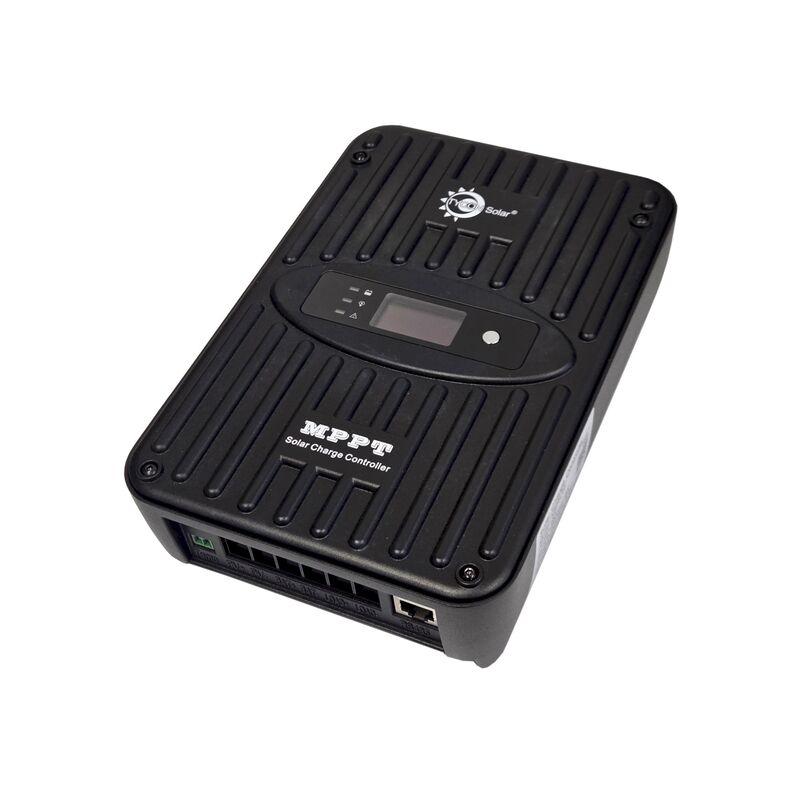
Explore Tycon Solar® solar charge controllers for MPPT, PWM, load-control, monitoring, and specialized remote-power applications.
Load Management Can Be Just as Important as Solar Production
Off-grid power design often focuses on generating more energy, but managing when and how equipment uses energy can also affect system performance.
Depending on the application, load-management strategies can include:
- Turning noncritical equipment off during low-battery conditions
- Operating selected loads only during daylight
- Scheduling communications or data uploads
- Separating critical and noncritical loads
- Using low-voltage disconnect thresholds
- Controlling equipment remotely when operating conditions change
Some of these functions can be implemented with fixed controller settings. More advanced systems can use external automation or analytical software to make decisions from multiple data sources.
Remote Monitoring Makes Smarter Decisions Possible
A system cannot make useful data-driven decisions without measurements. Remote monitoring therefore becomes the foundation for both conventional automation and more advanced analytics.
Useful measurements can include:
- Battery voltage
- Battery charge and discharge current
- Solar-array voltage and current
- Equipment load
- Battery and enclosure temperature
- Relay or equipment status
- Historical operating data
Tycon® TPDIN® monitoring and control products can provide remote measurements and control functions for distributed power and equipment installations.
Better Decisions Require Reliable Measurements
Whether the decision is made by a technician, a fixed automation rule, or an AI model, inaccurate voltage, current, temperature, or load data will produce poor results. Instrumentation and communications should therefore be treated as part of the system architecture.
Predictive Maintenance: Useful, but Not Magic
One promising use for analytics is identifying gradual changes before a complete failure occurs.
For example, historical data could reveal that battery voltage is recovering more slowly than it did previously, charging current has changed under similar solar conditions, or a communications load is consuming more energy than expected.
Those patterns may indicate that additional investigation is needed, but predictive software should not automatically be treated as proof that a specific component has failed.
Physical inspection and normal electrical troubleshooting remain important parts of maintaining remote solar infrastructure.
Weather Forecasting and Solar Energy Prediction
A more advanced energy-management system can combine historical solar performance with weather or irradiance forecasts to estimate future energy availability.
That information could help a system decide whether noncritical loads should be delayed, whether a battery reserve should be protected, or whether another available charging source should be used.
The usefulness of this approach depends on forecast quality, communications availability, system architecture, and the consequences of making an incorrect prediction.
Applications for Smarter Off-Grid Power
Remote Surveillance
Cameras, radios, cellular routers, and edge-processing equipment often operate continuously. Monitoring battery condition and load behavior can help operators understand whether changing site conditions are reducing available runtime.
Wireless and Telecommunications
Remote radios, access points, cellular gateways, and communications equipment can benefit from monitoring that distinguishes network issues from changes in the supporting power system.
Industrial Monitoring
Sensors, telemetry systems, PLCs, controllers, and industrial IoT equipment can combine process data with battery and power-system information to give operators a more complete view of a remote site.
Agriculture and Environmental Monitoring
Distributed sensors, weather stations, water monitors, and agricultural telemetry may already collect environmental information. Power-system data can be added to that monitoring architecture so operators can also evaluate the health of the equipment supplying energy to the site.
AI Does Not Replace Proper Solar System Sizing
No amount of software intelligence can create energy that the solar array does not generate or storage capacity that the battery bank does not have.
The fundamentals still determine whether the system can support the equipment:
- Daily equipment energy consumption
- Peak Sun Hours
- Seasonal solar conditions
- Required battery autonomy
- Battery chemistry and temperature
- Charge-controller limits
- System losses and future load growth
Size the Solar and Battery System Before Optimizing It
Start with the equipment load, operating time, site location, solar availability, and required battery reserve. Once those fundamentals are correct, monitoring and automation can help operators understand and manage the system more effectively.
Use the Power & Solar Calculators →Where RemotePro® Fits
RemotePro® is not an artificial-intelligence platform. It is a family of complete off-grid solar power systems designed around solar generation, battery storage, charge control, outdoor enclosure protection, and mounting for remote equipment.
RemotePro® off-grid solar power systems provide the physical power infrastructure that monitoring, automation, and higher-level analytics can build upon.
Where UPSPro® Fits
UPSPro® should not be described as an AI-powered solar charge controller either. It serves a different role: outdoor battery backup for equipment that already has a primary AC, DC, or PoE power source.
UPSPro® outdoor UPS and battery backup systems are appropriate when communications, monitoring, or other critical field equipment needs to remain operational through primary-power interruptions.
AI and Smart Solar Energy Management FAQs
Does an MPPT solar charge controller use artificial intelligence?
Not necessarily. MPPT is a control technique used to operate a solar array near its maximum power point. A controller can also provide programmable charging, load control, communications, and monitoring without using machine learning or AI.
What can AI do in an off-grid solar system?
AI can potentially analyze historical and real-time data to identify anomalies, estimate future energy availability, recognize changing load behavior, support predictive maintenance, or assist with energy-management decisions.
Can AI prevent a battery from failing?
AI cannot guarantee prevention of battery failure. Monitoring and analytics may identify changing behavior that suggests inspection or replacement is needed, but battery condition still depends on chemistry, age, temperature, cycling, charging, and other physical factors.
Is smart monitoring useful without AI?
Yes. Remote measurements, alarms, programmable load control, historical data, and remote access can provide substantial operational value even when all decisions are made by fixed rules or human operators.
Can AI compensate for an undersized solar system?
No. If the solar array cannot generate enough energy or the battery bank cannot provide the required autonomy, software cannot replace the missing physical capacity.
Are Tycon® solar systems AI-powered?
Tycon® products provide remote power, solar charging, battery backup, monitoring, communications, and control capabilities depending on the selected equipment. Those functions should not automatically be described as artificial intelligence. External analytics or automation platforms can use available system data where a project requires more advanced energy-management logic.
Start With Reliable Power and Useful Data
Tycon Systems® can help match solar generation, battery storage, charge control, monitoring, communications, load requirements, and environmental conditions to the remote application.
Request a System Design → Explore Solar Charge Controllers