




International PoE Day 2026: Powering the Future of Industrial and Remote Connectivity
International PoE Day 2026: Powering the Future of Industrial and Remote Connectivity
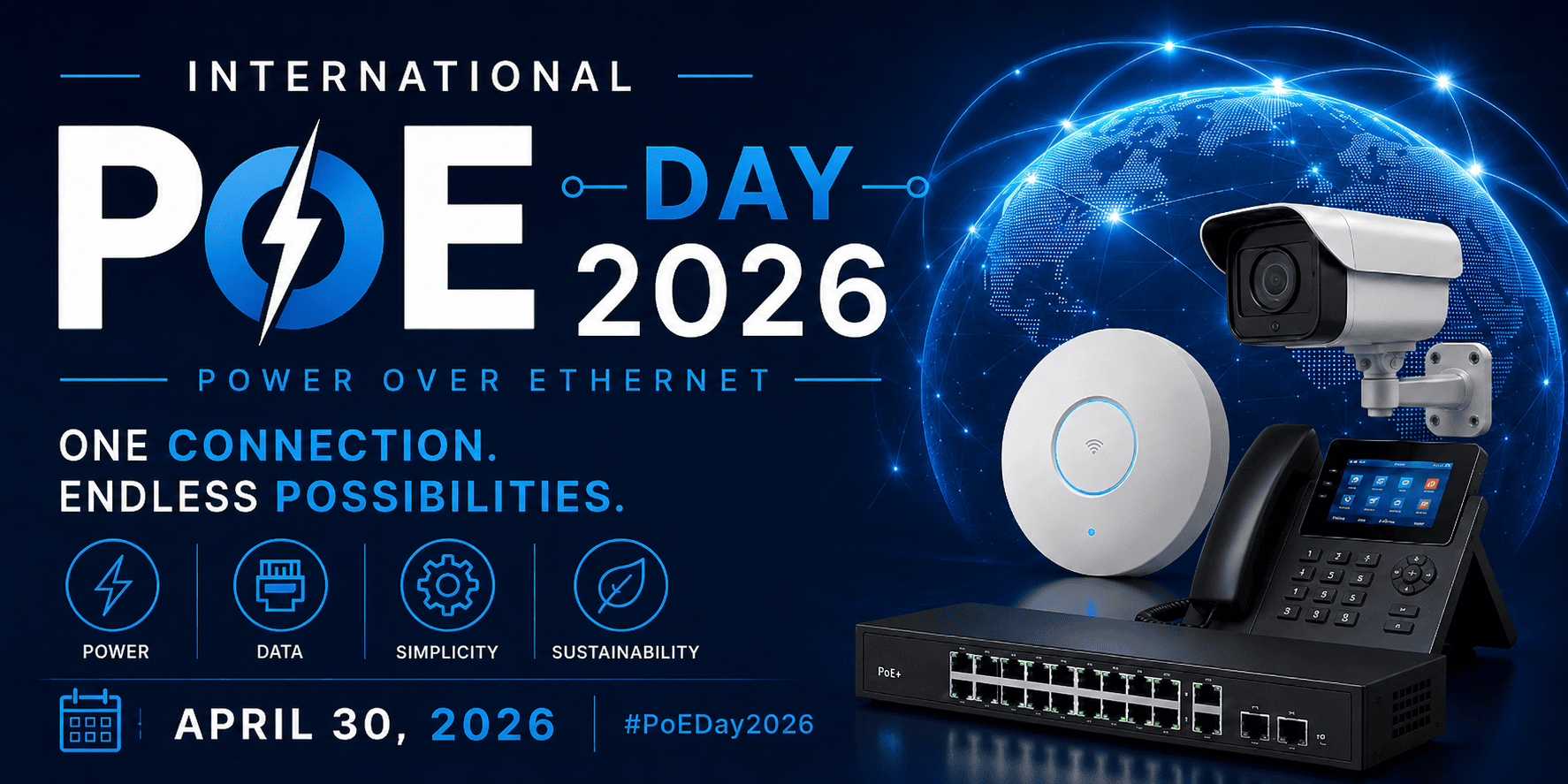
Power over Ethernet has become an important part of modern network infrastructure because it allows compatible devices to receive both electrical power and Ethernet data through the same cable. Cameras, wireless access points, radios, sensors, phones, access-control equipment, and other network devices can often be installed without providing a separate local power supply at every endpoint.
For International PoE Day 2026, it is worth looking beyond the convenience of a single Ethernet cable. In industrial and remote systems, PoE can also provide a practical bridge between network equipment and the DC, battery, solar, or backup-power infrastructure already available at the site.
What Is Power over Ethernet?
Power over Ethernet, or PoE, combines Ethernet communications and electrical power on the cabling connecting a network device.
Instead of installing an Ethernet cable for data and a separate power cable or AC outlet for the device, a compatible PoE source can deliver both through the network connection.
Common PoE-powered equipment includes:
- IP surveillance cameras
- Wireless access points
- Point-to-point wireless radios
- VoIP phones
- Access-control equipment
- Industrial Ethernet devices
- Sensors and IoT gateways
- Other network-connected field equipment
PoE Simplifies the Last Connection to the Device
PoE does not eliminate the need for a power source. It changes how that power is delivered to the network device. The PoE injector or switch still needs suitable AC, DC, battery, solar, or backup power upstream.
PoE Injector vs. PoE Switch
One of the first choices in a PoE design is how power will be added to the Ethernet connection.
PoE Injectors
A PoE injector adds electrical power to an existing Ethernet connection. This is useful when the network switch does not provide PoE or when only one or a small number of powered devices are required.
Tycon Power® offers AC, DC, passive and IEEE PoE injectors for cameras, wireless devices and network equipment.
PoE Switches
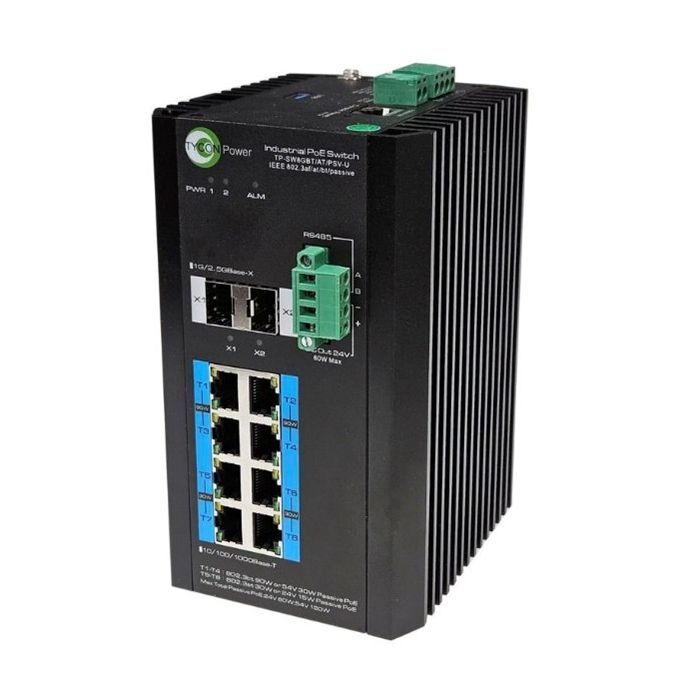
A PoE switch combines Ethernet switching and PoE delivery for multiple network devices. Depending on the model, switches may also provide management, fiber uplinks, VLANs, device monitoring, redundant power inputs, or other network features.
Explore Tycon Power® industrial PoE switches for cameras, radios, access points and distributed network equipment.
IEEE PoE and Passive PoE Are Not the Same
One of the most important details in PoE system design is determining what type of power the connected device actually accepts.
IEEE-standard PoE equipment uses defined negotiation and power-delivery methods. Common standards include IEEE 802.3af, 802.3at and 802.3bt, which support increasing levels of available device power.
Passive PoE is different. A passive injector applies the configured voltage to the Ethernet cable without the same IEEE detection and negotiation process.
For that reason, the PoE source needs to match the device's required voltage, pinout, power level and PoE method. A connector physically fitting into the Ethernet port does not by itself guarantee electrical compatibility.
Verify Voltage, Standard, Power and Network Speed
Check whether the device requires passive PoE or IEEE 802.3af, 802.3at or 802.3bt; confirm its input voltage and maximum power; and make sure the injector or switch supports the network speed required by the application.
Power Budget Matters
A multiport PoE switch may have enough ports for every connected device but still have an insufficient total power budget.
For example, cameras with heaters, pan-tilt-zoom motors, high-power wireless radios, access points and other demanding equipment may draw substantially more power than basic network devices.
A proper PoE calculation should therefore consider:
- Number of powered devices
- Maximum power required by each device
- PoE standard or passive voltage
- Total switch or injector capacity
- Available upstream power
- Future devices that may be added later
Industrial PoE Can Support Mixed Network Requirements
Industrial installations often contain devices with different PoE and network requirements. Some may need standard IEEE power, while others use passive PoE. Some may operate at Gigabit speeds while uplinks require fiber or higher bandwidth.
Selecting the network-power equipment around those requirements can reduce the number of separate converters, power supplies and injectors needed inside the installation.
DC-Powered PoE Is Especially Useful at Remote Sites
Most off-grid solar and battery systems produce DC power. Network equipment, however, may require 24V, 48V, 54V or 56V PoE at the Ethernet connection.
A DC/DC PoE injector can solve both problems at once by accepting the battery or DC-source voltage, converting it to the required output voltage, and adding that power to the Ethernet connection.
Tycon Power® DC/DC PoE injectors include configurations for common 12V, 24V and 48V battery systems as well as passive and IEEE PoE outputs.
PoE and Off-Grid Solar Work Together — But They Solve Different Problems
Solar produces the energy. Batteries store it. The charge controller manages battery charging. PoE then provides a practical way to deliver some of that available energy to compatible network devices.
Keeping those functions separate makes off-grid network systems much easier to understand and troubleshoot.
When a site has no dependable utility power, RemotePro® off-grid solar power systems can provide the solar generation, battery storage, charge control and outdoor power infrastructure. The appropriate Tycon Power® PoE equipment can then supply cameras, radios and network devices from that underlying DC power system.
Think in Layers
Solar array: Generates energy.
Battery: Stores energy for nighttime and low-sun periods.
Charge controller: Manages solar charging.
DC conversion / PoE: Converts and delivers the correct power to network equipment.
Connected device: Uses the power for cameras, radios, access points, sensors or other network functions.
PoE With Outdoor Battery Backup
A different architecture applies when primary power already exists.
If a camera, radio, access point or network device normally receives AC, DC or PoE power but needs to continue operating during an outage, the requirement is battery backup rather than primary off-grid generation.
UPSPro® outdoor UPS and battery backup systems are designed for that type of application.
PoE for Security Cameras
IP surveillance is one of the most common PoE applications. Cameras can receive network connectivity and electrical power through the same Ethernet run, simplifying installations on poles, buildings, trailers and remote structures.
Higher-power cameras may include pan-tilt-zoom mechanisms, heaters, IR illuminators or other accessories, so their maximum PoE requirement should be checked rather than assuming every camera uses the same amount of power.
Outdoor installations should also consider cable length, grounding, environmental protection and surge exposure as part of the complete design.
PoE for Wireless Networks
Wireless access points, point-to-point radios and outdoor network equipment are also natural PoE applications because the devices are frequently installed on roofs, towers or poles where providing a separate AC outlet would be inconvenient.
The challenge is that wireless equipment has historically used a wide range of passive and IEEE PoE configurations.
Always verify the radio's required voltage, pinout, power and network speed before selecting an injector or switch.
PoE for Industrial IoT and Monitoring
Industrial networks increasingly extend beyond climate-controlled IT rooms into warehouses, utility sites, transportation infrastructure, manufacturing facilities and remote field installations.
PoE can support compatible cameras, gateways, sensors, access points and other Ethernet devices while centralizing their power source.
Where remote equipment monitoring is also required, Tycon® TPDIN® monitoring and control products can provide additional visibility into voltage, current, temperature and equipment status in compatible installations.
Network Speed Matters Too
Selecting PoE equipment based only on voltage and wattage can create another problem: the injector or switch may not support the bandwidth required by the connected device.
Some applications need only 10/100Mb Ethernet. Others require Gigabit, 2.5G, 5G or 10G connectivity.
Tycon Power® offers PoE products across multiple network-speed classes, including high-speed DC-powered injectors intended for modern cameras, radios and network infrastructure.
Surge Protection Is Part of Outdoor PoE Design
Outdoor Ethernet cable can expose connected equipment to electrical transients associated with nearby lightning, grounding differences and other electrical events.
Surge protection should therefore be considered as part of an outdoor PoE installation rather than only after equipment has been damaged.
Correct grounding, cable routing, shielded equipment where required, and properly selected Ethernet or PoE surge protection all contribute to a more complete installation.
Start With What the Endpoint Requires
Identify the device's PoE standard, voltage, maximum wattage, network speed and connector requirements first. Then work backward through the injector or switch, available DC or AC source, backup requirements and upstream power system.
Choosing the Right Tycon Power® PoE Path
A useful starting point is:
Have AC power and need to add PoE to one device?
Start with an AC PoE injector.
Have battery or DC power?
Start with a DC/DC PoE injector.
Need to power several Ethernet devices?
Consider a PoE switch or multiport injector.
No utility power at the site?
Build the underlying power system with RemotePro® and match the PoE hardware to the connected devices.
Already have primary power but need outage protection?
Use UPSPro® as the battery-backup layer where appropriate.
Power over Ethernet FAQs
Does PoE carry power and data on the same cable?
Yes. PoE allows compatible Ethernet cabling to carry network communications and electrical power to the connected device.
What is the difference between passive PoE and IEEE PoE?
IEEE PoE standards such as 802.3af, 802.3at and 802.3bt use defined detection and power-delivery methods. Passive PoE normally applies a specified voltage without the same negotiation process, so device compatibility must be verified carefully.
Can PoE run from a 12V or 24V battery?
Yes, with appropriately selected DC/DC PoE hardware. A DC PoE injector or switch can accept the available battery voltage and provide the voltage and PoE configuration required by the network device.
Can PoE cameras run from solar power?
Yes. The solar and battery system must first be sized for the complete camera and networking load. DC/DC PoE hardware can then deliver the appropriate PoE power from the battery-based system to compatible devices.
Does RemotePro® monitor PoE devices?
RemotePro® should not be described as a PoE-device monitoring platform. It provides the off-grid solar and battery power infrastructure. Separate monitoring and network-management products can provide visibility into the power system or connected network devices where required.
Is UPSPro® an off-grid solar system?
No. UPSPro® is intended primarily for battery backup where a normal AC, DC or PoE source already exists. RemotePro® is the appropriate Tycon Solar® family when the site needs primary off-grid solar power.
How do I choose the correct PoE injector?
Start with the connected device's required PoE method, voltage, maximum power and network speed. Then match those requirements to the available AC or DC power source and any environmental or mounting requirements.
Start With the Device and the Available Power Source
Tycon Systems® can help match cameras, wireless equipment, PoE standards, network speed, DC input voltage, battery power, backup requirements and remote-site conditions to the appropriate network-power solution.
Explore Tycon Power® → Request a System Design