Powering Arctic Research: A Tycon Systems® Case Study
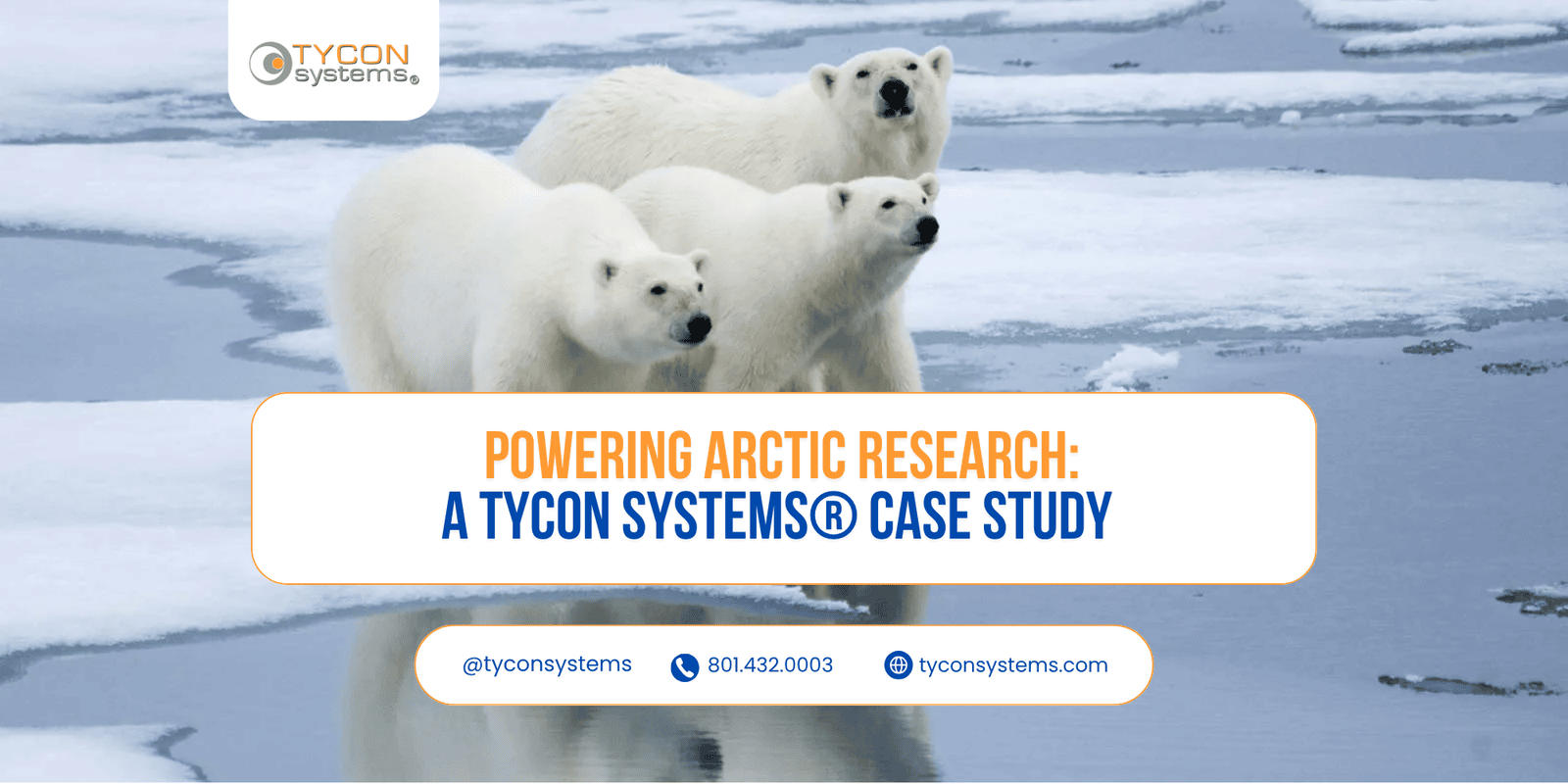
Remote research becomes especially challenging when the equipment must operate for weeks without technicians nearby. In the Arctic, environmental conditions, difficult access, communications limitations, and the need to avoid disturbing wildlife make reliable field power an essential part of the research system.
Polar Bears International uses remote camera systems in northern Canada and Svalbard, Norway to study polar bear mothers and cubs during the denning season. The equipment may remain deployed and unattended for 8 to 12 weeks, requiring the power, networking, monitoring, and recording systems to work together in an extremely remote environment.
The Challenge: Research Equipment That Must Operate Unattended
Each spring, Polar Bears International deploys up to six camera systems near polar bear denning areas. Once the equipment is positioned, researchers need to leave the area relatively undisturbed while the systems collect video and supporting research data.
That creates a very different power problem from equipment installed at a building or conventional communications site.
The deployment needs to support:
- High-resolution camera equipment
- Multiple networked devices
- PoE power distribution
- Voltage conversion
- Remote monitoring when communications are available
- Autonomous operation when connectivity is unavailable
- Extended operation without routine maintenance visits
When a Service Visit Is Not a Simple Option
Remote research systems need to be designed around more than normal operating power. Battery reserve, environmental conditions, communications availability, equipment protection, voltage conversion, monitoring, and the consequences of a failure all become more important when technicians cannot simply visit the site.
The Solution: Build the Power Architecture Around the Equipment
The Arctic camera system uses several Tycon Systems® products to distribute power, provide the required equipment voltage, and monitor system conditions.
The deployed configuration includes the TP-SW8-D PoE switch, TP-VRHP-1256 voltage converter, and TPDIN-Monitor-WEB3 remote monitoring and control device.
Rather than treating power, networking, and monitoring as separate systems, these components work together as part of the infrastructure supporting the cameras and sensors.
TP-SW8-D PoE Switch
The TP-SW8-D distributes Ethernet connectivity and PoE power to multiple network devices. Using PoE allows power and network data to reach compatible cameras and other equipment through Ethernet cabling, simplifying the wiring inside a compact remote system.
The switch supports eight ports and is designed for DC-powered PoE applications, making it useful where the site's power originates from batteries rather than conventional AC infrastructure.
View the TP-SW8-D PoE Switch →
TP-VRHP-1256 Voltage Converter
Battery systems and network equipment do not always operate at the same voltage. The TP-VRHP-1256 converts a 10–15VDC input into regulated 56VDC output for equipment that requires the higher voltage.
This type of DC-to-DC conversion makes it possible to maintain a practical battery architecture while supplying the voltage required by the PoE equipment. View the TP-VRHP-1256 →
TPDIN-Monitor-WEB3 Remote Monitoring
Remote monitoring becomes especially valuable when the equipment is hundreds or thousands of miles from the people responsible for it.
The TPDIN-Monitor-WEB3 can monitor voltage, current, temperature, and other operating information and provides relay-control capabilities. When network connectivity is available, this gives operators greater visibility into the condition of the remote equipment.
Explore the TPDIN-Monitor-WEB3 →

Why PoE Is Useful in a Remote Camera System
Remote surveillance and research cameras often need both network connectivity and electrical power. Power over Ethernet allows those functions to share the same cable for compatible devices.
That can reduce the amount of separate field wiring and simplify power distribution when several network devices are located inside or near the same remote equipment package.
Tycon Power® offers PoE switches for cameras, wireless equipment, networking devices, and other remote Ethernet applications.
DC Voltage Conversion Simplifies Mixed-Voltage Systems
One common challenge in remote systems is that the battery bank and connected electronics may require different operating voltages.
Instead of designing the entire battery system around the highest-voltage device, DC-to-DC conversion can create the required regulated output locally.
Tycon Power® DC voltage converters support applications where cameras, radios, PoE equipment, controllers, and other electronics need a different voltage from the primary battery or DC source.
Remote Monitoring Matters More as Site Access Becomes Harder
At an ordinary installation, a technician may be able to visit the equipment when a problem appears. Arctic research sites are fundamentally different.
When connectivity is available, remote monitoring can provide information that helps researchers or technicians understand the state of the power system without disturbing the research location.
Depending on the system architecture, useful measurements can include:
- Battery voltage
- Current consumption
- Temperature
- Equipment or relay state
- Historical operating data
- System alarms or abnormal conditions
This does not eliminate the need for robust system design. It simply gives operators better information when physical access is difficult.
Remote Monitoring Complements Reliability — It Does Not Replace It
Monitoring is useful when communications are available, but the Arctic system also needs to continue operating autonomously. That makes local power capacity, correct voltage conversion, equipment protection, and a stable network architecture the foundation of the deployment.
The Result: Weeks of Autonomous Field Operation
With the remote power and communications system deployed, the research cameras can remain in the field for weeks while researchers avoid disturbing the denning area.
The camera systems capture high-resolution video used to study polar bear behavior. The project also supports research involving tracking information and environmental sensors.
The deployment demonstrates an important remote-infrastructure principle: reliable field systems are built by matching the power architecture to the actual equipment, environment, service constraints, and communications requirements.
Lessons for Other Remote Monitoring Projects
Most remote projects will never face the exact conditions of an Arctic polar bear research station, but many of the same design principles apply to industrial, environmental, security, communications, and research deployments.
Design for the Complete Load
Cameras and sensors rarely operate alone. Include network switches, radios, converters, routers, controllers, heaters, monitoring equipment, and any other supporting electronics in the power calculation.
Match Voltage at the System Level
Battery voltage does not need to dictate the voltage of every connected device. Appropriate DC conversion can allow several types of equipment to operate from one underlying power architecture.
Reduce Unnecessary Field Wiring
PoE can simplify compatible camera and network installations by delivering power and Ethernet connectivity through the same cable.
Plan for Limited Communications
A remote system should not become unusable simply because external communications are temporarily unavailable. Critical local functions should continue according to the requirements of the application.
Make Monitoring Part of the Design
When network access is available, remote voltage, current, temperature, and equipment-state information can make troubleshooting and maintenance planning considerably more useful.
Different Remote Sites Need Different Power Architectures
The Arctic deployment uses individual Tycon® power, PoE, conversion, and monitoring components because its requirements are highly specialized. Other remote monitoring projects may be better served by a preconfigured off-grid solar platform.
RemotePro® off-grid solar power systems combine solar generation, battery storage, charge control, enclosure protection, and mounting for cameras, sensors, wireless equipment, telemetry, and other field electronics.
Explore RemotePro® →Remote Research Power FAQs
How long were the Arctic camera systems left unattended?
The case study describes deployments lasting approximately 8 to 12 weeks, during which researchers needed the equipment to operate without routine maintenance visits.
What Tycon® products were used in the Arctic research system?
The documented system includes the TP-SW8-D PoE switch, TP-VRHP-1256 DC voltage converter, and TPDIN-Monitor-WEB3 remote monitoring and control device.
Why use a voltage converter in a battery-powered system?
A DC voltage converter allows equipment requiring a different voltage to operate from the site's primary battery architecture. In this application, the TP-VRHP-1256 converts a 10–15VDC input to regulated 56VDC output.
Why is PoE useful for remote research cameras?
PoE can deliver Ethernet data and electrical power to compatible equipment through the same network cable, simplifying distributed camera and communications installations.
Can the system operate without an internet connection?
The documented deployment was designed to support autonomous field operation as well as remote monitoring when connectivity was available. The specific capabilities of another installation will depend on its equipment and system architecture.
Can Tycon Systems® help design a similar remote research system?
Tycon Systems® can help evaluate equipment load, operating voltage, PoE requirements, battery storage, solar generation, monitoring, environmental conditions, and other requirements for remote research and field infrastructure projects.
Start With the Equipment, Environment and Required Runtime
Tycon Systems® can help match cameras, sensors, PoE equipment, voltage conversion, monitoring, solar generation, battery storage, and environmental requirements to a remote field deployment.
Request a System Design → Explore RemotePro®