

Powering Remote Living: A Tycon Systems® Case Study
Powering Remote Living: A Tycon Systems® Case Study
Living or working far from utility infrastructure changes the way electrical power needs to be designed. A remote cabin may need only modest amounts of continuous power when it is unoccupied, but those loads can still include internet connectivity, security cameras, monitoring equipment, lighting, and other electronics that need to remain available day and night.
This Tycon Systems® deployment near Mt. Pleasant, Utah shows how a properly sized solar and battery system can reduce dependence on a diesel generator while supporting both continuous background loads and the additional electrical needs of an occupied recreational cabin.
The Challenge: Reliable Power Beyond the Grid
The 2,200-square-foot recreational cabin is located in a mountainous area where utility power is unavailable. Before the solar system was installed, electricity came from a diesel generator.
A generator can be useful when the cabin is occupied and electrical demand is relatively high. It is less convenient for small loads that need to operate continuously while no one is there.
Those background loads included:
- Security cameras
- Internet and wireless connectivity
- Monitoring equipment
- Other always-available cabin electronics
The objective was therefore not simply to replace a generator. It was to create a power architecture that could support the cabin's regular low-level demand automatically while still providing useful electrical capacity when people were using the property.
What Needs to Run When Nobody Is There?
Remote cabins often have two very different power profiles: continuous unattended loads and larger intermittent loads when the property is occupied. Separating those requirements makes it much easier to determine what should be supported by solar and batteries and when another backup source may still be useful.
Start With the Continuous Electrical Load
The cabin's average continuous load was approximately 210W. That included equipment that needed to remain available even when the owners were away.
Continuous loads deserve particular attention in an off-grid system because they consume energy every hour. Security cameras, networking equipment, wireless bridges, routers, monitoring devices, and other always-on electronics can create a substantial energy requirement even when each individual device has relatively modest power consumption.
Correct sizing therefore begins with the complete load rather than simply selecting a solar-panel wattage or battery size.
The Solution: 1,440W of Solar With 720Ah of Battery Storage
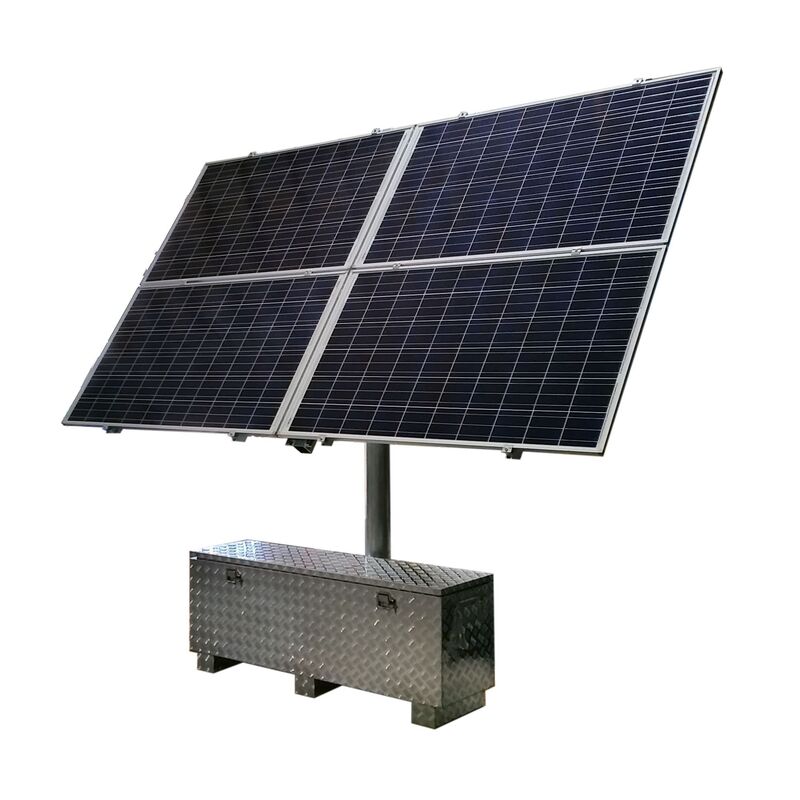
The installed Tycon Systems® solution was configured with approximately 1,440W of solar generation and 720Ah of battery storage.
Solar energy charges the battery bank during the day, while the stored energy supports the cabin when solar production is reduced or unavailable. This allows the continuous loads to operate without requiring the diesel generator to run simply to support relatively small electrical demands.
The generator was retained as a backup source rather than removed from the overall power strategy.
Why the Solar Array Was Ground Mounted
Installing solar panels on the cabin roof was considered, but the roof was not the best location for this project. Structural considerations and the available roof angles would have made it more difficult to place the array for favorable solar exposure.
Instead, the solar array was ground mounted away from the cabin. This allowed the installation location and panel orientation to be selected around sunlight availability, with particular attention to winter conditions when solar energy is more limited.
A conduit connection between the solar installation and the cabin carries the required power and data infrastructure.
Ground Mounting Can Solve More Than One Problem
Roof mounting is convenient for many solar projects, but remote installations should not assume that the roof is automatically the best location.
A separate ground mount may provide advantages when:
- The roof orientation is poor for solar production
- Roof structure or condition makes installation undesirable
- A different part of the property has better sunlight
- Seasonal shading affects the building
- Panel access for service is important
- A larger array would be difficult to accommodate on the roof
Mounting decisions should consider solar exposure, wind, snow, terrain, cable distance, access, structural requirements, and applicable installation standards.
Winter Performance Matters in Mountain Locations
An off-grid system that performs well during long summer days may behave very differently during winter.
Cold-season design should account for:
- Fewer available solar hours
- Lower sun angle
- Seasonal shading
- Snow accumulation
- Battery temperature
- Cold-weather PV open-circuit voltage
- Periods of consecutive poor solar production
In the documented cabin deployment, the system continued maintaining the batteries through winter conditions while supporting the unattended security and monitoring loads.
Powering More Than Just Security Cameras
The system supports the continuous security and communications requirements, but the cabin also uses solar-generated energy for other electrical loads when occupied.
Documented loads include:
- Lighting
- Ceiling fans
- Wireless bridge equipment
- Security cameras
- Video projector
The mix illustrates why remote-cabin sizing should consider both the baseline electrical demand and the additional loads expected while the property is occupied.
Not Every Cabin Load Needs the Same Priority
Internet equipment, security cameras, and monitoring may need to operate continuously. Entertainment equipment, lighting, fans, tools, or other cabin loads may be intermittent. Understanding those differences can help determine battery reserve, solar capacity, and when a backup generator should remain part of the system.
Keeping the Generator as Backup Can Be a Sensible Design Choice
Solar does not have to eliminate every other energy source to be useful.
In this project, the existing diesel generator remained available as backup even after the solar and battery system was installed. According to the documented deployment, normal operation had not required the generator after the solar system was placed in service.
Retaining another charging or generation source can provide additional flexibility during unusual energy demand, extended low-sun periods, maintenance, or other operating conditions.
Connectivity Is Part of Modern Remote Living
Remote living no longer necessarily means operating without communications. The cabin uses a wireless bridge to maintain connectivity, and the security-camera system can remain active while the property is unattended.
Networking equipment should be included in the energy calculation just like lighting or other electrical loads. Radios, routers, switches, cameras, PoE equipment, and monitoring devices can operate continuously and therefore have a significant effect on daily energy consumption.
Tycon Wireless® and Tycon Power® products can provide wireless connectivity, PoE, DC conversion, and related network-power functions when those components are part of a remote-site design.
Remote Monitoring Can Be Especially Valuable for Seasonal Properties
A seasonal cabin may remain unattended for extended periods. The ability to check the power system or connected equipment remotely can therefore reduce uncertainty about conditions at the property.
Depending on the system configuration, useful measurements can include:
- Battery voltage
- Solar charging performance
- Load current
- Temperature
- Equipment status
- Historical operating information
Tycon® TPDIN® monitoring and control products provide options for adding remote visibility and control to compatible power installations.
What This Remote Cabin Project Demonstrates
The most useful lesson from this project is not that every remote cabin needs 1,440W of solar or 720Ah of battery storage. Those numbers were selected for this particular property, load profile, location, and operating requirements.
Another cabin may require substantially less or substantially more capacity.
A remote-cabin design should consider:
- Continuous background load
- Additional occupied load
- Installation location
- Seasonal Peak Sun Hours
- Battery autonomy
- Winter conditions
- Generator or other backup availability
- Importance of uninterrupted communications or security
Use the Case Study as a Design Example, Not a Fixed Formula
Start with your actual electrical loads, operating schedule, location, solar exposure, desired battery reserve, and backup-power strategy. Tycon Systems® calculators can help establish the initial requirements before specific hardware is selected.
Use the Power & Solar Calculators →RemotePro® for Larger Off-Grid Power Requirements
RemotePro® includes configurations ranging from compact pole-mounted systems for cameras and radios through larger ground-mounted systems capable of supporting more demanding off-grid loads.
A current example is the RPAL24/48M-720-1440, which combines 1,440W of solar capacity with 720Ah of battery capacity and is specifically listed for applications including remote cabins.
Explore RemotePro® off-grid solar power systems →
Remote Cabin Solar FAQs
Can solar completely replace a generator at a remote cabin?
It can in some applications, but that should not be assumed. The answer depends on the electrical load, available sunlight, battery capacity, seasonal conditions, acceptable operating limits, and how much backup capability the owner wants to retain.
How much solar does an off-grid cabin need?
Solar capacity should be calculated from the actual daily energy requirement, location, seasonal solar resource, system losses, battery capacity, and desired battery-recovery time. Cabin size alone does not determine the required solar array.
Should solar panels be mounted on the cabin roof or on the ground?
Either approach can work. The better location depends on structural conditions, orientation, shading, wind and snow requirements, service access, available land, cable distance, and the amount of solar capacity required.
Can an off-grid solar system support internet and security cameras?
Yes, when the complete communications and surveillance load is included in system sizing. Routers, wireless bridges, switches, cameras, and PoE equipment can operate continuously and should all be included in the energy calculation.
Why keep a generator after adding solar?
A generator can provide another energy source during unusual loads, extended periods of poor solar production, maintenance, or other conditions. Keeping it as backup does not prevent solar and battery power from handling normal operation.
Can Tycon Systems® help size a remote cabin power system?
Yes. The useful starting information includes the complete equipment list, wattage, operating schedule, installation location, desired battery autonomy, available backup sources, and environmental conditions.
Start With What Needs to Run When the Grid Is Not an Option
Tycon Systems® can help match continuous and intermittent loads, solar generation, battery storage, backup charging, communications, monitoring, mounting, and site conditions to an off-grid application.
Request a System Design → Explore RemotePro®