

Juneteenth 2026: Solar Power for Community Events | Tycon®
Juneteenth, observed each year on June 19, commemorates a defining moment in American history. On June 19, 1865, Union troops arrived in Galveston, Texas, and announced that enslaved Black people in the state were free. Today, Juneteenth National Independence Day is an opportunity to recognize that history, reflect on the meaning of freedom, and take part in community traditions that have developed across generations.
In 2026, Juneteenth falls on Friday, June 19. Communities across the country may mark the day with educational programs, festivals, gatherings, parades and other public events.
For event planners and municipal teams, one practical consideration is the temporary infrastructure required to support those gatherings. Cameras, wireless networks, communications equipment, registration systems and lighting may need power in parks, parking areas or other locations where permanent electrical service is limited. Solar and battery power can be one option for those specific field loads when the system is properly sized.
Start With What the Event Actually Needs to Power
Temporary solar should not be approached as a generic replacement for every electrical service at a community event.
Large sound systems, food-service equipment, HVAC, refrigeration and other high-power loads may require substantially more electrical capacity than a typical mobile remote-power system is designed to provide.
A stronger fit for Tycon® mobile solar systems includes:
- Security cameras
- Temporary WiFi access points
- Point-to-point wireless radios
- Cellular routers
- Event communications equipment
- Registration or information equipment
- Selected LED lighting
- Sensors and monitoring equipment
- Other compatible DC and PoE field electronics
Temporary Power Still Requires Real System Sizing
List every device, its voltage, wattage and expected operating time before selecting the solar panels or batteries. The event schedule does not determine system size—the electrical load does.
MobileSolarPro® for Temporary Event Infrastructure
Community events are temporary by nature, which makes a mobile power platform more appropriate than a permanently installed off-grid system in many cases.
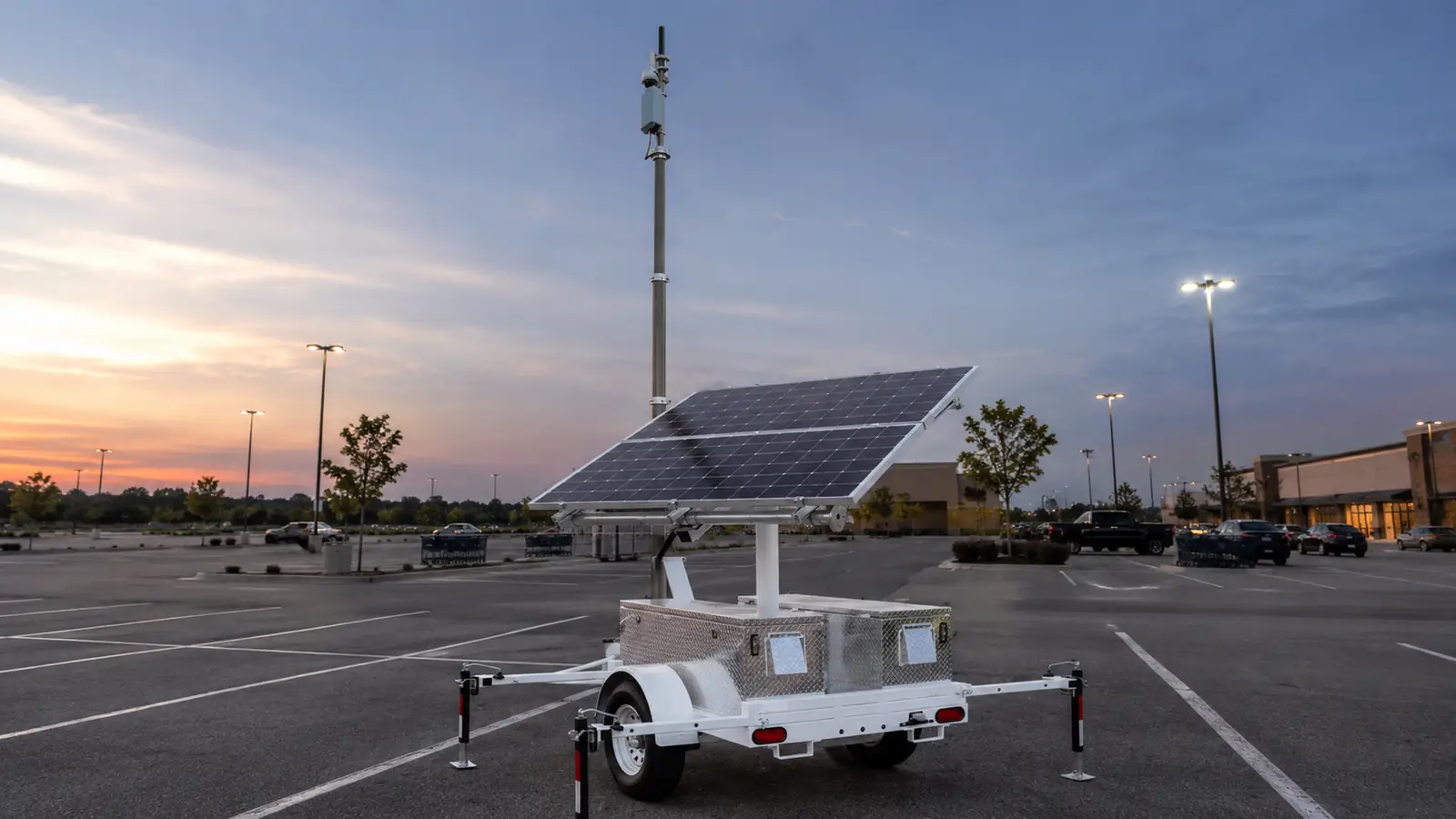
MobileSolarPro® trailers and skids combine solar charging, battery storage and field-ready power outputs on a platform that can be transported or repositioned as site requirements change.
Current MobileSolarPro® applications include events, parking lots, temporary surveillance, lighting, wireless equipment, emergency response and other locations where power or connectivity needs to move with the project.
Explore MobileSolarPro® trailers and skids →
Security and Visibility Around the Event Site
Public gatherings may extend into parking lots, entrances, temporary staging areas or other locations beyond convenient building infrastructure.
A mobile solar platform can provide local power for cameras and communications equipment without requiring temporary electrical wiring to be run across large areas of the site.
Mast-mounted cameras can also provide elevated visibility where the equipment, mounting arrangement and site conditions support the installation.
Temporary WiFi and Communications
Connectivity has become an important part of many public events.
Temporary networks may support:
- Event staff communications
- Registration systems
- Information stations
- Security cameras
- Operational monitoring
- Other connected field equipment
Outdoor access points, wireless bridges and cellular routers can be powered from a battery-based system when the required voltage, wattage and PoE method are correctly matched.
Tycon Power® PoE equipment provides options for powering compatible cameras, radios and other Ethernet devices from DC sources.
Calculate Energy, Not Just Watts
Equipment wattage tells you how much power a device consumes at a particular moment. Battery and solar sizing also require knowing how long that device will operate.
A simple starting point is:
Device Watts × Hours of Operation = Watt-Hours of Energy
For example, a 20W device operating for 10 hours consumes approximately 200Wh before accounting for system losses.
Repeat that calculation for every powered device. Cameras, routers, switches, radios and lighting all contribute to the total event energy requirement.
Battery Capacity Matters After the Sun Goes Down
An event that extends into the evening cannot rely on real-time solar production alone.
Battery storage needs to support the required loads after sunset and during periods when solar generation is below the electrical demand.
Battery sizing should consider:
- Total event energy consumption
- Expected operating hours
- Battery chemistry
- Allowable depth of discharge
- Temperature
- System conversion losses
- Reserve capacity required by the application
Afternoon Sunshine Does Not Guarantee Evening Runtime
If critical equipment needs to remain online through teardown or after sunset, battery capacity should be sized around that required operating window rather than assuming the solar array will carry the load throughout the event.
Lighting Can Be a Significant Load
MobileSolarPro® can support compatible temporary lighting, but the lighting requirement should be calculated carefully because fixtures can consume substantially more energy than cameras or networking equipment.
Determine fixture wattage, quantity and operating duration before assuming the lighting can be added to an existing power configuration.
High-output stage lighting and large entertainment loads belong in a different class from modest site, security or operational lighting and may require dedicated event-power infrastructure.
What Role Does RemotePro® Play?
RemotePro® is designed primarily for fixed installations that need dependable primary off-grid solar power.
If a municipality or community organization has a permanent remote camera, gate, sensor or wireless device at a park or gathering area, a fixed RemotePro® off-grid solar system may be appropriate.
For equipment that only appears during temporary events, MobileSolarPro® is generally the more natural Tycon® starting point because the power platform can move with the application.
What Role Does UPSPro® Play?
UPSPro® should not be described as the battery-management system inside an off-grid solar installation.
UPSPro® is primarily an outdoor battery-backup family for compatible equipment that already has a normal AC, DC or PoE power source but needs to remain operating through a power interruption.
If a permanent camera, network device or communications system at an event venue already has primary power, an UPSPro® outdoor UPS may provide the backup architecture the site needs.
Monitoring Is Useful, but Verify Where It Comes From
RemotePro® itself is not a monitoring dashboard.
Supported MobileSolarPro® configurations can provide remote visibility into solar, battery, load and temperature information, while compatible Tycon® systems can also use dedicated monitoring hardware.
The TPDIN® monitoring and control family includes equipment that can monitor voltage, current and temperature and provide remote control functions in compatible installations.
Solar and Generators Can Work Together
Temporary solar power does not require organizers to treat generators as the enemy.
Some applications can operate entirely from solar and battery storage. Others may benefit from another charging source when the event load is larger, the operating period is long, weather is uncertain or uninterrupted service is especially important.
Current MobileSolarPro® systems can support solar charging in the field with AC charging available for generator or grid input when the selected configuration and site design require it.
Site Planning Matters as Much as Electrical Sizing
A temporary power system also needs an appropriate physical location. Consider:
- Available sunlight
- Pedestrian and vehicle traffic
- Trailer or skid placement
- Mast clearance
- Wind and weather conditions
- Cable routing
- Camera or wireless line-of-sight
- Access for setup, inspection and removal
Event organizers should also follow applicable local electrical, permitting, traffic-control and public-safety requirements for temporary equipment installations.
Seven Questions Before Selecting a Mobile Solar System
1. What equipment needs power?
2. What voltage and wattage does each device require?
3. How many hours will each device operate?
4. Which loads must remain available after sunset?
5. Are DC, PoE or AC outputs required?
6. Where can the trailer or skid be positioned safely?
7. Is another charging source or backup system required?
Juneteenth Event Power FAQs
When is Juneteenth in 2026?
Juneteenth National Independence Day falls on Friday, June 19, 2026.
What does Juneteenth commemorate?
Juneteenth commemorates June 19, 1865, when Union troops arrived in Galveston, Texas, and announced and enforced freedom for enslaved Black people in the state. Juneteenth celebrations grew from that history and have continued for generations.
Can MobileSolarPro® power equipment at community events?
Yes, when the electrical load fits the selected configuration. Current MobileSolarPro® applications include events, temporary lighting, surveillance, wireless equipment and remote monitoring.
Can it power an entire festival stage?
Do not assume so. Large audio systems, stage lighting, refrigeration, cooking equipment and other high-power loads can exceed the capabilities of typical remote-power configurations. Size the system from actual equipment requirements.
Can solar power event equipment after dark?
Yes, through battery storage. The battery bank must contain enough usable energy to support the required loads for the planned operating period.
Can a mobile solar trailer support cameras and WiFi?
Yes. Current MobileSolarPro® systems support compatible cameras, radios, routers, switches and other DC or PoE equipment when the power and networking requirements are correctly matched.
How should temporary event solar be sized?
Start with every connected device, its voltage, wattage and operating time. Then consider battery runtime, available sunlight, temperature, system losses, required output types, physical deployment requirements and whether another charging source is needed.
Start With the Equipment and Operating Hours
Tycon Systems® can help evaluate cameras, communications equipment, WiFi, PoE devices, lighting and other compatible field loads and determine whether a MobileSolarPro® trailer, skid or another remote-power architecture fits the application.
Explore MobileSolarPro® → Request a System Design