

Off-Grid Solar Security for Remote Infrastructure | Tycon® Case Study
Securing critical infrastructure becomes more difficult when the location that needs surveillance is also the location that is hardest to reach with electrical and network infrastructure.
Evidence Security LLC encountered exactly that problem at a water treatment facility where a remote turnpike underpass gate had become a security concern. Unauthorized access, damaged locks, and gates being left open created a need for continuous visibility—but the site was located too far from convenient electrical service for a conventional camera installation to make economic sense.
The Challenge: Monitor a Vulnerable Access Point Without Grid Power
The underpass gate was positioned in a remote corner of the facility. Providing conventional electrical service would have required additional wiring, trenching, and electrician labor simply to reach the monitoring location.
That created two separate infrastructure challenges:
- Provide dependable power for continuous video surveillance.
- Transmit camera data approximately 2 kilometers back to the central monitoring station.
Solving only one of those problems would not be enough. Cameras without communications would provide limited remote visibility, while a wireless connection without dependable local power would still leave the surveillance point vulnerable to outages.
Remote Surveillance Requires Both Power and Connectivity
A remote camera installation is only as reliable as the infrastructure behind it. Solar and batteries can supply the energy, while Ethernet, cellular, fiber, or point-to-point wireless communications provide the path back to the monitoring network.
The Solution: A 280W RemotePro® Off-Grid Solar System
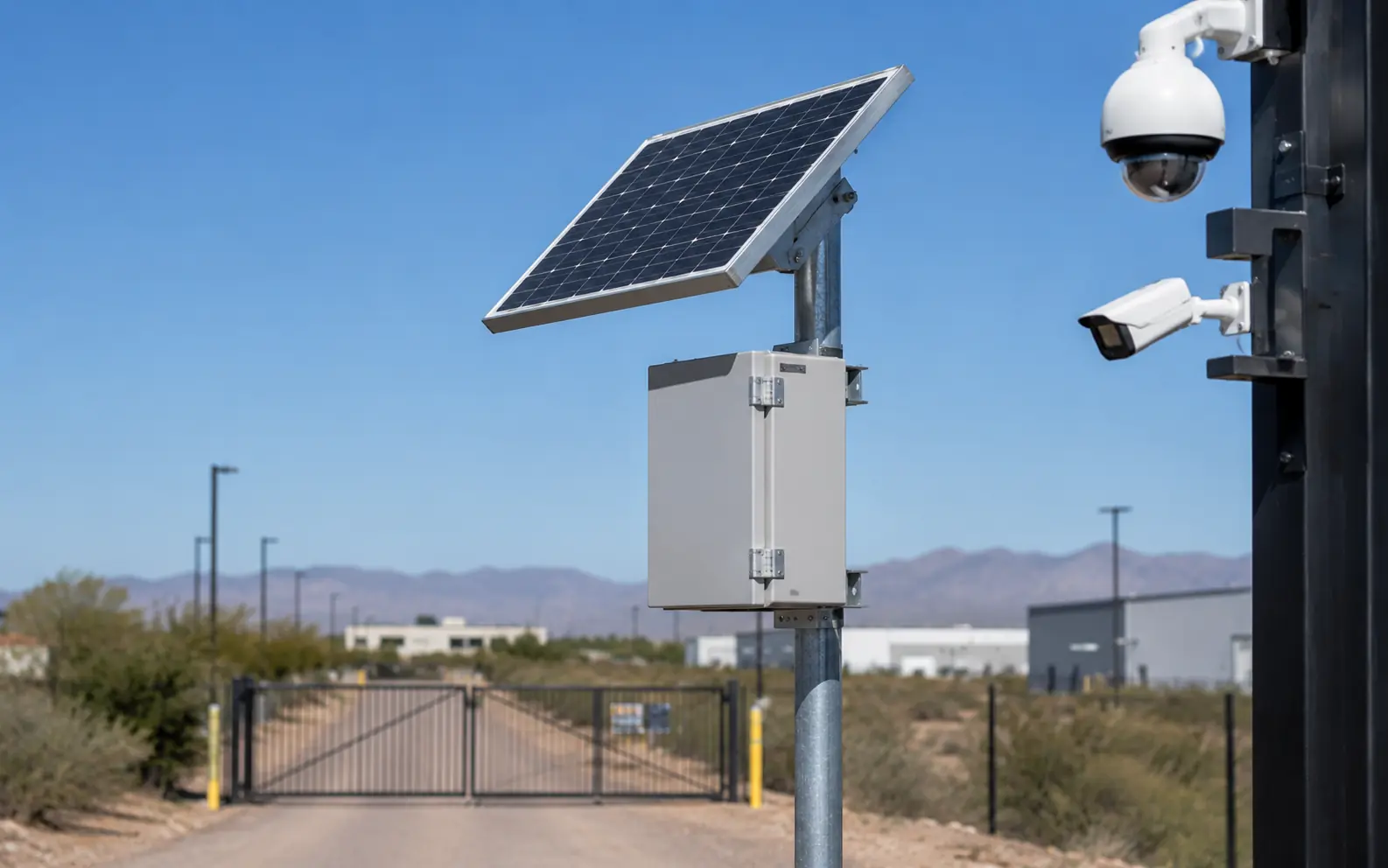
Evidence Security LLC deployed a Tycon Systems® 280W RemotePro® solar power system directly at the remote gate.
The RemotePro® system provided local solar generation and battery storage, eliminating the need to extend utility power to the surveillance location.
Two security cameras were mounted at the site and powered from the off-grid system, allowing the underpass gate and surrounding area to be monitored continuously without relying on a nearby AC electrical connection.
Why Solar Was a Practical Fit for This Site
The alternative was not simply “solar versus an electrical outlet.” An electrical outlet did not exist where the cameras were needed.
Providing utility power would have required additional infrastructure to move electricity from an existing source to the gate. For a relatively modest surveillance load, generating and storing the energy directly at the equipment provided a more practical architecture.
This type of approach can be particularly useful when:
- The equipment load is relatively low and predictable.
- Utility power is far from the installation point.
- Trenching or long electrical runs would be disruptive.
- The site needs unattended operation.
- Cameras or communications equipment need 24-hour power.
- The location has adequate solar exposure for the required system size.
Battery Storage Keeps the Cameras Running After Sunset
Solar panels generate energy only when sufficient sunlight is available, but security cameras may need to operate continuously.
Battery storage bridges that gap by storing energy produced during the day and supplying it to the cameras and communications equipment when solar production falls below the system load.
This is why off-grid surveillance systems need to be sized from daily energy consumption, expected sunlight, battery autonomy, equipment voltage, temperature, and the importance of uninterrupted operation—not from solar-panel wattage alone.
The Communications Challenge: Approximately 2 Kilometers
Powering the cameras solved only half of the problem. Operators still needed access to the video from the facility's central monitoring station approximately 2 kilometers away.
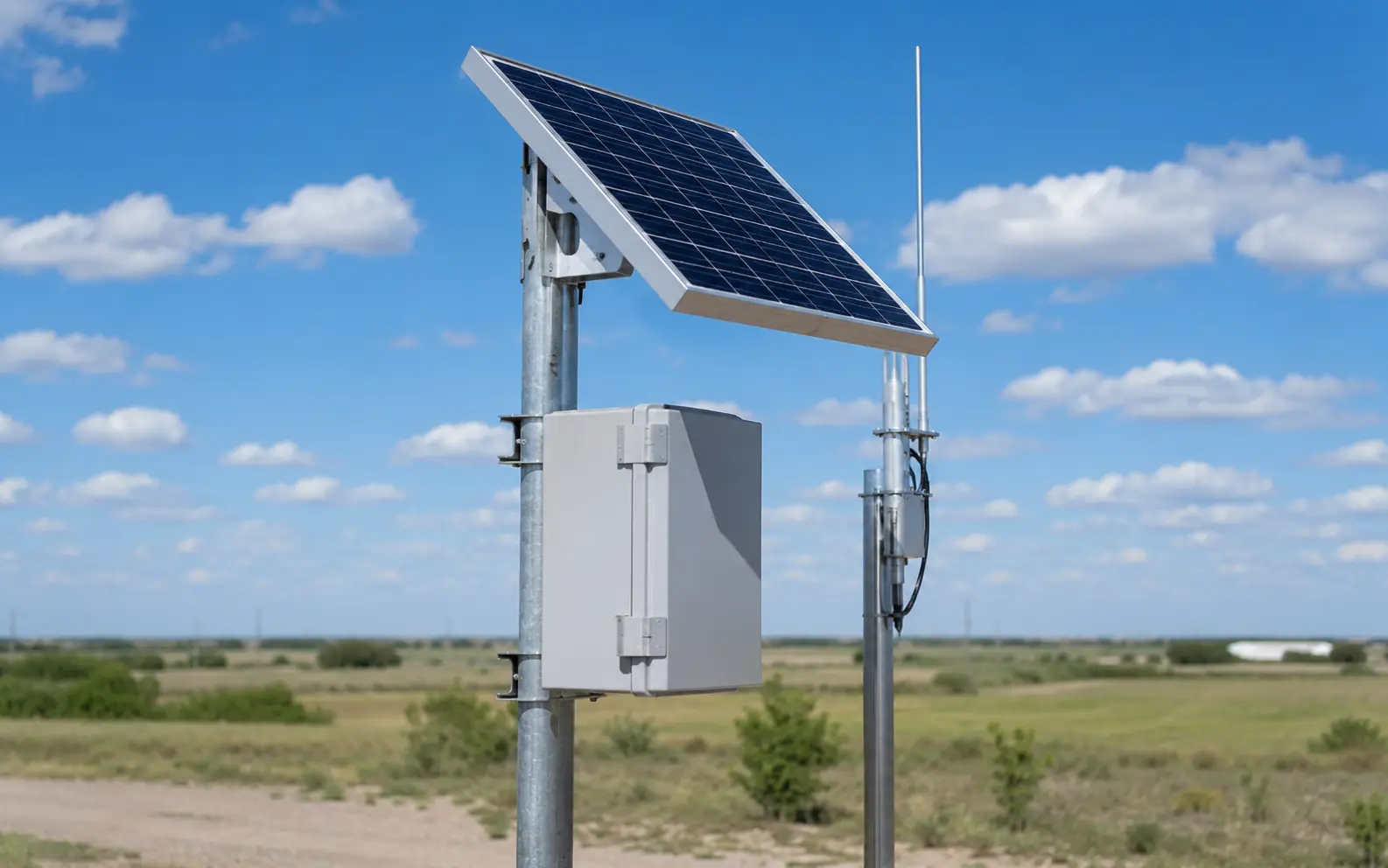
The deployment used a Ubiquiti NanoStation M5 wireless device to establish a point-to-point communications link between the remote surveillance location and the central network.
That allowed camera video and data to cross the distance wirelessly rather than requiring new communications cabling between the gate and the central station.
A Wireless Link Still Needs to Be Engineered
The approximately 2-kilometer link in this project was specific to this installation. Wireless range should never be assumed from distance alone.
A new point-to-point link should consider:
- Clear line-of-sight between both locations
- Fresnel-zone clearance
- Radio frequency
- Antenna gain and alignment
- Local RF interference
- Available mounting height
- Required network throughput
- Weather and environmental conditions
The wireless radio also becomes part of the solar-system load and must be included when calculating battery and solar requirements.
Camera + Network + Power = One System
When sizing remote surveillance, include every device required to deliver usable video: cameras, wireless radios, routers, PoE injectors or switches, heaters, illuminators, and any monitoring or control equipment.
The Result: Continuous Visibility at a Previously Vulnerable Gate
With the RemotePro® system and wireless link installed, the facility gained continuous surveillance of an access point that had previously been difficult to monitor.
The cameras could operate without local utility power while the point-to-point wireless connection returned video to the central monitoring station.
By avoiding the need for new electrical service at the gate, the project reduced installation complexity and eliminated the long power run that would otherwise have been required.
More importantly, operators gained better visibility into activity around a known security vulnerability and were better positioned to identify and respond to unauthorized access.
What This Case Study Demonstrates
The value of this deployment is not simply that solar panels powered two cameras.
It demonstrates how three different infrastructure functions can be combined:
Surveillance: Two cameras monitor the remote gate and surrounding area.
Remote power: A 280W RemotePro® system supplies solar generation and battery-backed energy without utility service at the monitoring point.
Connectivity: A point-to-point wireless link carries the camera data approximately 2 kilometers back to the central monitoring station.
When those layers are designed together, equipment can be placed where the application actually requires it rather than only where power and network infrastructure happen to exist.
Other Critical Infrastructure Applications
The same general architecture can be useful at other distributed infrastructure locations where security or monitoring is needed beyond convenient utility service.
Water and Wastewater Facilities
Remote gates, tanks, pump stations, reservoirs, equipment areas, and perimeter locations may require cameras, telemetry, or communications equipment away from the main facility.
Utility Infrastructure
Substations, remote equipment sites, pipelines, and distributed utility assets may need surveillance or monitoring where conventional electrical service is unavailable.
Transportation Infrastructure
Underpasses, gates, remote intersections, construction projects, and roadside equipment can require cameras and wireless communications far from existing buildings.
Industrial Facilities
Equipment yards, remote entrances, storage locations, tanks, pipelines, and perimeter sites may benefit from independent surveillance and communications.
Remote Properties and Access Points
Gates, driveways, agricultural properties, storage areas, and other isolated access points can be monitored without extending electrical service to every location.
RemotePro® for Fixed Off-Grid Security Sites
The system documented in this project used a 280W RemotePro® configuration. Because the exact historical model number is not identified here, a new project should not assume that the same configuration is automatically appropriate.
Current RemotePro® systems range from compact pole-mounted configurations through substantially larger systems and can support cameras, wireless bridges, access points, sensors, telemetry, and other field electronics.
Explore RemotePro® off-grid solar power systems →
Size a New System for the New Site
The 280W configuration was selected for this deployment. A different camera count, wireless radio, operating voltage, climate, solar resource, or required battery autonomy can produce a very different system requirement.
Remote Infrastructure Security FAQs
What equipment did the RemotePro® system power?
The documented deployment used a 280W RemotePro® solar power system to support two security cameras and the remote communications equipment needed at the surveillance site.
How far was the surveillance site from the monitoring station?
The central monitoring station was approximately 2 kilometers from the remote gate. A Ubiquiti NanoStation M5 was used as part of the point-to-point wireless connection.
Can security cameras run completely from solar power?
Yes, when the solar array, battery capacity, charge control, and supporting power equipment are properly sized for the complete camera and communications load.
Can solar cameras operate at night?
Yes. Battery storage supplies the equipment when solar generation is unavailable or insufficient. Required battery capacity depends on the load and desired autonomy.
Can a wireless bridge operate from an off-grid solar system?
Yes. The radio's voltage and energy consumption simply need to be included in the system design along with the cameras and other network equipment.
Will every wireless bridge work over 2 kilometers?
No. The approximately 2-kilometer distance was specific to this deployment. Wireless performance depends on radio selection, antenna configuration, line-of-sight, Fresnel clearance, interference, frequency, mounting height, and terrain.
How do I size solar power for a remote security site?
Begin with every powered device, its voltage and wattage, operating hours, installation location, solar conditions, required battery autonomy, communications hardware, and environmental requirements.
Start With the Cameras, Communications Equipment and Location
Tycon Systems® can help match cameras, wireless equipment, PoE requirements, solar generation, battery storage, mounting, and environmental conditions to a remote surveillance deployment.
Request a System Design → Explore RemotePro®