




The Impact of Solar on Reducing Carbon Emissions in Industry
The Impact of Solar on Reducing Carbon Emissions in Industry
Industrial sustainability is often discussed in terms of large factories, utility-scale renewable energy, and corporate emissions targets. But industry also depends on thousands of smaller pieces of infrastructure operating far from traditional buildings: sensors, cameras, wireless radios, telemetry, industrial IoT devices, cellular routers, controllers, and monitoring equipment.
Providing power to those remote devices can require grid extensions, long electrical runs, generators, repeated battery replacement, or other supporting infrastructure. In the right application, solar generation combined with battery storage can provide power directly at the equipment while reducing dependence on fossil-fuel energy and unnecessary infrastructure.
How Does Solar Power Reduce Industrial Carbon Emissions?
Solar generation can reduce emissions when the electricity it produces replaces energy that would otherwise come from a more carbon-intensive source.
In industrial applications, that can happen in several ways:
- Replacing electricity drawn from the utility grid
- Reducing generator operating hours at remote sites
- Reducing the need for repeated battery replacement at low-power field sites
- Powering equipment locally instead of extending electrical infrastructure
- Supporting efficient low-voltage DC equipment directly from battery-based systems
- Reducing some service and fuel-delivery requirements at difficult-to-access locations
The actual environmental benefit depends on what energy source is displaced, how much energy the solar system produces, how the equipment is used, battery replacement, transportation, and the expected service life of the installation.
Solar Capacity Alone Does Not Tell You the Emissions Reduction
A 100W, 1kW, or 500kW solar array does not automatically represent a fixed amount of avoided CO₂. Actual solar generation varies by location, orientation, weather, shading, and system performance, while avoided emissions depend on the electricity or fuel being replaced.
Calculate Carbon Reduction From Energy Actually Replaced
A more defensible carbon calculation starts with measured or reasonably estimated energy production.
For grid-connected applications, the basic concept is:
Solar electricity replacing grid electricity × applicable grid emissions factor = estimated avoided emissions
For a remote site that would otherwise depend on a generator, the calculation should instead consider how much generator fuel or generator-produced electricity the solar system actually displaces.
This approach is more useful than applying one generic carbon-savings number to every solar installation.
Remote Industrial Sites Are a Different Solar Opportunity
Tycon Systems® primarily addresses a different part of industrial solar than large rooftop arrays supplying manufacturing plants.
Many industrial operations have distributed equipment located beyond convenient utility service. These field devices may consume relatively little power individually but still require dependable 24-hour operation.
Examples include:
- Pipeline and tank monitoring
- Environmental sensors
- Industrial IoT gateways
- Remote PLC and telemetry equipment
- Security cameras
- Cellular routers
- Wireless communications
- Water and utility monitoring
- Remote network infrastructure
Supplying energy locally with solar and battery storage can be particularly practical for these types of low-to-moderate-power industrial loads.
Generate Energy Where the Industrial Equipment Operates
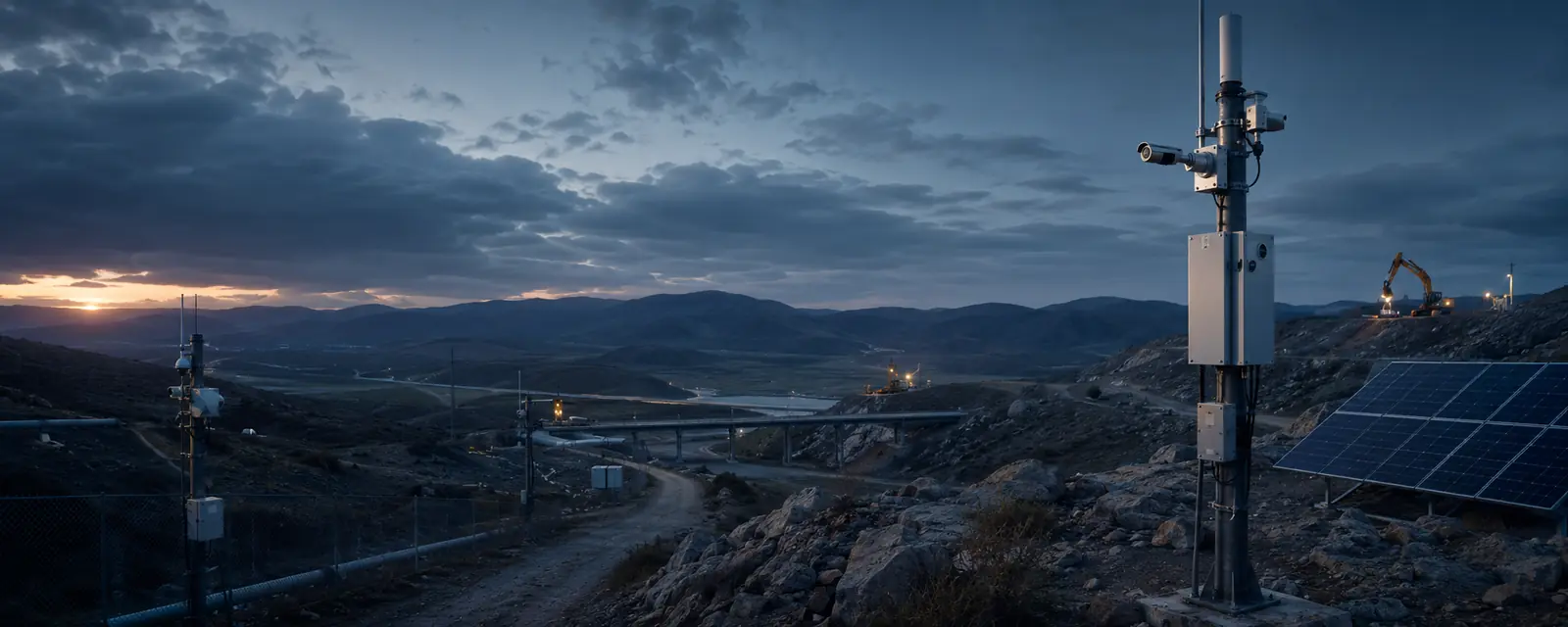
Distributed industrial infrastructure often exists because the equipment needs to be close to the asset being monitored rather than close to an electrical outlet.
Solar allows the energy source to follow the equipment into those remote locations. Battery storage then supports the load at night and during periods when solar generation is insufficient.
Reducing Generator Dependence at Remote Industrial Sites
Generators remain useful for many industrial applications, especially where loads are large, intermittent, or critical enough to justify multiple energy sources.
But continuously operating a generator to supply relatively small sensor, communications, or monitoring loads can create fuel, service, transportation, noise, and maintenance requirements that are disproportionate to the electrical demand.
Where sunlight and load conditions are appropriate, solar and battery storage can provide the primary energy source while a generator remains available as backup or supplemental charging.
In that type of hybrid architecture, emissions reduction depends on how many generator operating hours and how much fuel consumption are actually avoided.
Energy Efficiency Multiplies the Benefit
Before adding more solar panels or batteries, reducing the equipment load can often improve the entire system.
Opportunities can include:
- Selecting lower-power sensors or communications equipment
- Using efficient DC-to-DC conversion
- Avoiding unnecessary DC-to-AC-to-DC conversion
- Using sleep modes where the application permits
- Reducing communications duty cycle where practical
- Turning noncritical equipment off when it is not needed
- Separating critical and noncritical loads
Every watt removed from a continuous 24-hour load reduces daily energy consumption and can also reduce the amount of solar generation and battery storage required.
The Lowest-Carbon Watt Is Often the Watt You Do Not Need to Generate
Reducing a continuous field load can shrink the solar array, battery bank, wiring and supporting power hardware. Efficiency therefore affects both operating energy and the physical size of the remote power system.
Battery Storage Makes Remote Solar Practical
Industrial sensors and communications equipment may need power around the clock, while solar generation is available only when adequate sunlight reaches the array.
Battery storage bridges that difference.
The battery should be sized around daily energy demand, required autonomy, chemistry, allowable depth of discharge, temperature, system losses, expected aging, and the consequences of an interruption.
Browse Tycon Solar® batteries for remote power and battery-backup applications.
RemotePro® for Primary Off-Grid Industrial Power
RemotePro® should not be described as an intelligent monitoring platform. Its primary role is providing complete off-grid solar power where dependable utility service is unavailable.
Current RemotePro® systems combine solar generation, battery storage, charge control, outdoor enclosure protection, mounting, and related power hardware for sensors, communications equipment, surveillance, wireless systems, and other field electronics.
Explore RemotePro® off-grid solar power systems →
UPSPro® Solves a Different Industrial Power Problem
UPSPro® is not an industrial solar-energy-storage system and should not be presented as the mechanism responsible for reducing emissions.
UPSPro® provides outdoor battery backup for equipment that already has a normal AC, DC, or PoE power source but needs continued operation during interruptions.
Explore UPSPro® outdoor UPS and battery backup systems →
Monitoring Helps Verify That the Remote System Is Working
Carbon calculations and sustainability claims become more useful when the underlying system performance can be measured rather than assumed.
Remote power monitoring can also help operators identify weak batteries, unexpected load changes, charging problems, or equipment conditions that might otherwise result in unnecessary site visits.
Depending on the installed hardware, useful measurements can include:
- Battery voltage
- Charge and discharge current
- Solar input
- Equipment load
- Temperature
- Historical operating information
Tycon® TPDIN® monitoring and control products provide options for remote measurement and control in compatible industrial power installations.
Industrial Applications Where Remote Solar Can Make Sense
Oil, Gas and Pipeline Monitoring
Pressure, flow, tank, valve, communications, and environmental monitoring equipment may be located across large geographic areas where extending conventional electrical service to every measurement point would be impractical.
Water and Utility Infrastructure
Remote telemetry, cameras, radios, sensors, and control equipment can require local power at reservoirs, pump stations, tanks, substations, and other distributed assets.
Industrial IoT
Sensors, gateways, cellular routers, PLCs, edge devices, and telemetry systems can be deployed closer to the processes and assets they monitor when power does not need to be extended from a traditional building.
Security and Surveillance
Cameras and communications equipment at remote gates, equipment yards, transportation infrastructure, utility sites, and industrial perimeters can use solar and battery power where grid service is unavailable.
Environmental Monitoring
Air, water, weather, emissions, and environmental sensors frequently need power in exactly the locations where conventional infrastructure is least convenient to provide.
Mobile Solar Can Reduce Temporary Infrastructure
Some industrial power requirements are temporary rather than permanently remote.
Construction projects, temporary security operations, equipment yards, emergency response, industrial staging, and maintenance projects may need cameras, communications, lighting, or monitoring before permanent infrastructure exists.
MobileSolarPro® solar trailers and skids provide transportable solar generation and battery storage for temporary and movable field applications.
Carbon Reduction Should Be Based on What the Solar System Actually Replaces
Replacing grid electricity? Track solar kWh and use the appropriate electricity emissions factor.
Replacing generator operation? Track the fuel or generator energy no longer required.
Reducing field visits or fuel delivery? Treat those as additional project effects rather than assuming they are included in the solar-energy calculation.
Cost Savings and Carbon Savings Are Not the Same Calculation
A project can reduce emissions without producing the same financial result at every site.
Economics can depend on:
- Utility-extension cost
- Generator purchase and fuel
- Service and maintenance
- Battery replacement
- Site-access cost
- Solar resource
- Equipment life
- Value of avoiding downtime
For that reason, neither ROI nor carbon reduction should be presented as one universal percentage for industrial solar projects.
Proper System Sizing Matters for Sustainability Too
An unnecessarily oversized system uses more panels, batteries, mounting hardware, cabling, and enclosure capacity than the application requires.
An undersized system can create the opposite problem: poor reliability, excessive battery cycling, repeated service visits, or dependence on another charging source.
Good system design aims for enough generation and storage to meet the application requirements without treating “more hardware” as the answer to every design problem.
Size the System Before Selecting the Hardware
Define equipment wattage, operating hours, location, available sunlight, battery autonomy, environmental conditions, and any backup energy source before selecting panels and batteries.
Use the Power & Solar Calculators →Industrial Solar and Carbon Reduction FAQs
Does solar power produce zero carbon emissions?
Solar panels do not burn fuel while producing electricity, but manufacturing, transportation, installation, batteries, maintenance, and eventual equipment replacement still have environmental impacts. Carbon claims should therefore distinguish operational energy from full lifecycle impacts.
How do I calculate the carbon reduction from a solar system?
Start with the amount of energy the solar system actually produces and determine what grid electricity, generator fuel, or other energy source it replaces. Apply an appropriate emissions factor for that displaced source.
Can solar reduce diesel-generator use?
Yes, when the solar array and battery bank are capable of supporting the connected load. Some sites may operate primarily from solar while retaining a generator for backup or supplemental charging.
Is RemotePro® for industrial applications?
RemotePro® can support industrial field equipment including sensors, telemetry, wireless communications, cameras, monitoring devices, and other low-voltage remote electronics when utility power is unavailable.
Does UPSPro® reduce carbon emissions?
UPSPro® is primarily an outdoor battery-backup product family. It should not automatically be described as an emissions-reduction technology. Its role is maintaining power to compatible equipment during interruption of the normal power source.
Can remote monitoring help an industrial solar system?
Monitoring can provide visibility into battery condition, charging, load behavior, temperature, and other operating information. That information can support maintenance and help verify that the power system is operating as expected.
What industrial loads are best suited to Tycon® remote solar systems?
Tycon® systems are particularly suited to remote cameras, wireless equipment, cellular routers, sensors, telemetry, industrial IoT, monitoring equipment, and other field electronics rather than facility-scale manufacturing loads.
Start With the Load, Site and Existing Energy Source
Tycon Systems® can help match sensors, communications equipment, cameras, industrial electronics, solar generation, battery storage, monitoring, mounting, and environmental requirements to a remote field deployment.
Request a System Design → Explore RemotePro®