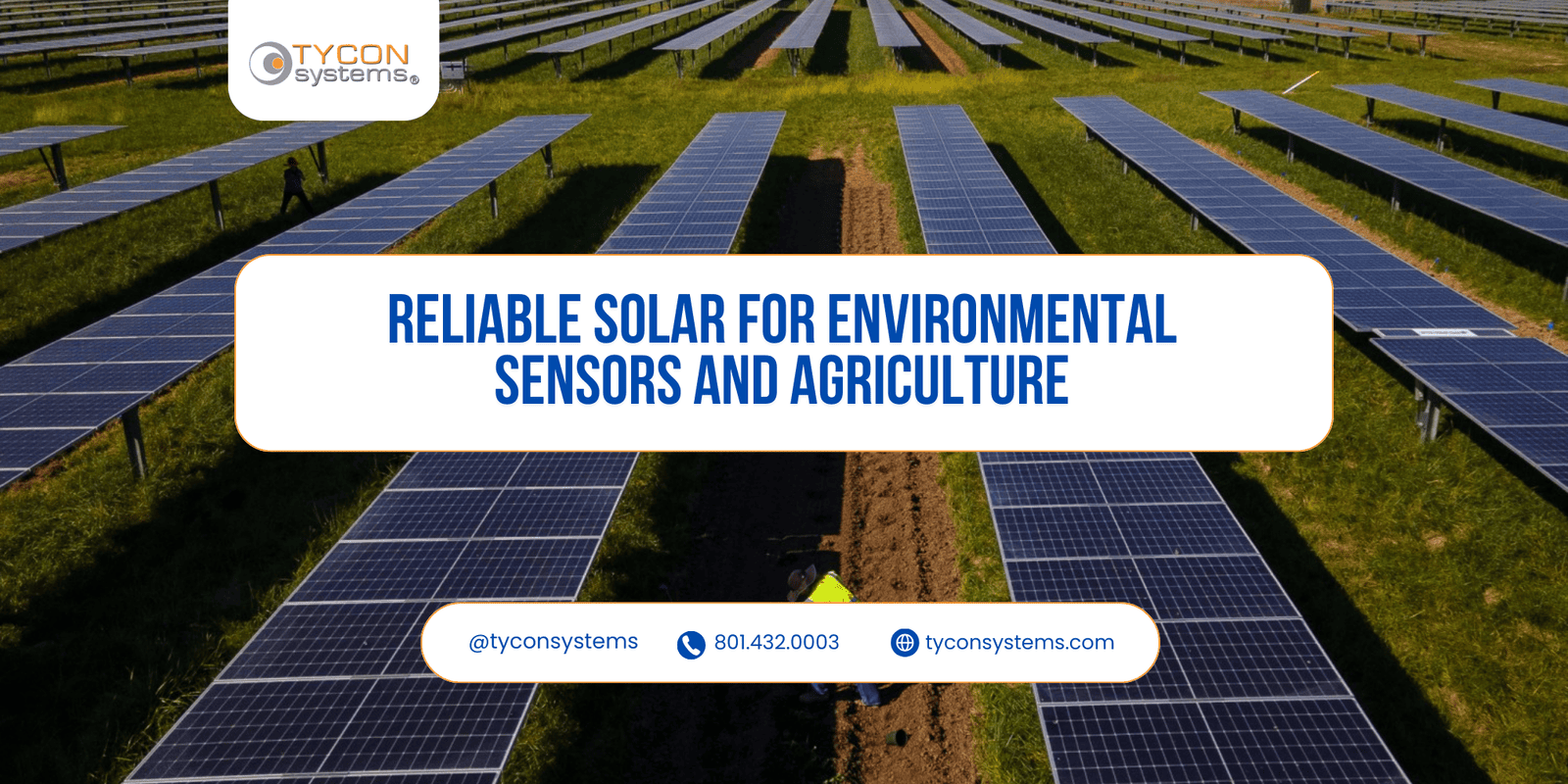
Reliable Solar Power for Environmental Sensors and Agriculture Monitoring
Reliable Solar Power for Environmental Sensors and Agriculture Monitoring
Environmental sensors and agricultural monitoring equipment are increasingly deployed far from buildings, utility service, and other traditional infrastructure. Soil sensors, weather instruments, water-quality monitors, telemetry systems, cellular gateways, irrigation controls, and research equipment may all need dependable power at locations where extending electrical service would be difficult or impractical.
Solar power can provide that energy locally, while battery storage keeps monitoring equipment operating when solar production is low or unavailable. The key is to design the complete system around the actual sensor load, communications equipment, available sunlight, required battery autonomy, and environmental conditions at the site.
Why Remote Sensors Need Their Own Power Strategy
Modern monitoring networks often distribute small electronic devices across large areas. A single sensor may use very little power, but the complete field station can also include a data logger, wireless radio, cellular router, controller, heater, pump interface, or other supporting electronics.
That makes the total system load more important than the power rating of any one sensor.
Typical remote monitoring equipment can include:
- Soil moisture and soil temperature sensors
- Weather instruments
- Water-level and water-quality monitoring
- Environmental data loggers
- Cellular and wireless gateways
- Telemetry radios
- Irrigation monitoring and control equipment
- Industrial IoT sensors and controllers
Solar Power in Precision Agriculture
Precision agriculture depends on collecting useful information from the field rather than relying only on observations from a central location.
Distributed sensors can provide information about soil moisture, temperature, rainfall, humidity, weather conditions, water availability, and other variables that help operators make better decisions about irrigation, crop management, and resource use.
Solar power is useful in these applications because the energy source can be installed beside the monitoring equipment instead of requiring electrical service to be extended across fields, pastures, research plots, or other large areas.
Environmental Monitoring Beyond Agriculture
The same remote-power approach can support monitoring outside agricultural applications.
Examples include:
- Wetland and watershed monitoring
- River and reservoir instrumentation
- Remote weather stations
- Forestry and conservation monitoring
- Wildlife research equipment
- Air-quality monitoring
- Remote research stations and telemetry sites
Each application has different power and reliability requirements, so the solar system should be selected around the actual electronics and site rather than assuming that one standard sensor-power package will work everywhere.
Small Sensor Loads Can Still Add Up
A monitoring device drawing only a few watts may operate 24 hours per day. Add a cellular router, radio, data logger, controller, or other electronics and the daily energy requirement can become much larger than the sensor specification alone suggests. Calculate the complete load before choosing the panel or battery.
Calculate the Complete Monitoring Load
List every device that will receive power from the system and determine its operating voltage, power consumption, and daily operating time.
Include supporting equipment such as:
- Sensor electronics
- Data loggers
- Wireless or cellular communications
- PoE converters or switches
- Controllers and relays
- Heaters or environmental controls
- Future equipment expansion
Converting the total load into daily watt-hours gives the starting point for solar-array and battery sizing.
Size the Solar Array for the Location
Solar-panel wattage should be based on how much energy the equipment consumes and how much usable sunlight is available at the site.
Peak Sun Hours, seasonal weather, panel orientation, shading, temperature, system losses, and desired battery-recovery time all affect the required array size.
Explore Tycon Solar® solar panels for compact remote loads through larger field-power systems.
Battery Storage Determines Sensor Runtime
Battery storage allows monitoring equipment to continue operating overnight and during periods when solar generation is insufficient.
Capacity should be based on the daily equipment load, desired autonomy, battery chemistry, allowable depth of discharge, operating temperature, expected aging, and system losses.
A monitoring site expected to continue collecting data through several low-sun days may need substantially more battery storage than a system where brief interruptions are acceptable.
Browse Tycon Solar® batteries for off-grid solar and field-power applications.
Choose the Correct Solar Charge Controller
The solar charge controller manages energy flowing from the solar array into the battery bank and may also provide load-control functions.
Controller selection should account for battery voltage, battery chemistry, PV input voltage, charging current, solar-array size, and any load-control or monitoring requirements.
Compare Tycon Solar® MPPT and PWM solar charge controllers for different remote monitoring configurations.
Communications Equipment Can Be a Major Part of the Load
The sensor itself is often not the largest energy consumer at a remote monitoring station. A cellular router, wireless radio, gateway, PoE device, or always-on data connection may use as much or more energy than the instrument collecting the measurements.
Communications equipment should therefore be included from the beginning of the power-system design.
Where possible, operating schedules, sleep modes, data-transmission intervals, and load-control strategies can also affect total daily energy use.
Remote Monitoring of the Power System
Environmental and agricultural sites may already be collecting remote data, so it can also be useful to monitor the condition of the power system supporting that equipment.
Depending on the installation, useful information can include:
- Battery voltage
- Charge and discharge current
- PV voltage and current
- Battery or enclosure temperature
- Load status
- Historical system data and alarms
Tycon® TPDIN® monitoring and control products provide options for remotely monitoring voltage, current, temperature, equipment state, and solar-system operating information.
Design for the Days When Solar Production Is Poor
Reliable sensor operation should not be based only on a clear summer day. Battery autonomy and solar capacity should be evaluated against seasonal sunlight, cloudy periods, temperature, equipment duty cycle, and the importance of maintaining uninterrupted data collection.
Common Agricultural Monitoring Applications
Soil Moisture Monitoring
Soil-moisture sensors can help operators understand field conditions and make more informed irrigation decisions. Remote solar power can support the sensor, data logger, communications hardware, and related electronics where utility power is unavailable.
Remote Weather Stations
Weather-monitoring equipment can measure temperature, humidity, rainfall, wind, solar conditions, and other variables useful for agriculture, environmental research, and site management.
Irrigation Monitoring and Control
Remote controllers, valves, telemetry equipment, and field sensors can help operators monitor irrigation systems across areas where conventional electrical infrastructure is limited.
Livestock and Remote Property Monitoring
Water tanks, gates, pumps, cameras, sensors, and communications equipment may be located across large farms or ranches. Solar and battery systems can provide localized power where extending AC service would be impractical.
Research and Environmental Field Stations
Universities, agencies, utilities, and research organizations can use off-grid power for instrumentation and communications at water, climate, wildlife, agricultural, and environmental monitoring sites.
Plan for Maintenance and Site Access
Solar power can reduce the need for fuel delivery or conventional electrical infrastructure, but every remote system still requires appropriate inspection and maintenance.
Consider:
- Panel cleaning and new shading
- Battery condition
- Cable and connector condition
- Mounting hardware
- Enclosure seals and ventilation
- Vegetation growth
- Changes to the connected sensor or communications load
Need More Than a Solar Panel and Controller?
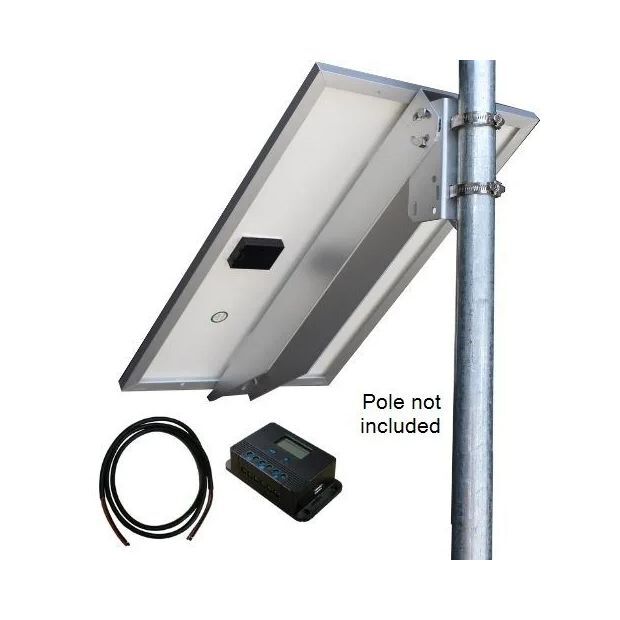
A compact solar kit can be useful when the battery, enclosure, wiring, voltage conversion, and equipment architecture are already defined. When those pieces still need to be selected together, a complete RemotePro® system may be the better starting point.
RemotePro® off-grid solar power systems combine solar generation, battery storage, charge control, outdoor enclosure protection, and mounting for sensors, telemetry, wireless equipment, cameras, communications systems, and other remote electronics.
Explore RemotePro® →When UPSPro® Is More Appropriate
Not every monitoring station is completely off-grid. Some locations already have AC, DC, or PoE power but need the sensor network or communications equipment to remain online during interruptions.
In those applications, UPSPro® outdoor UPS and battery backup systems provide a more appropriate path than designing a primary off-grid solar system.
Calculate the Load Before Selecting the Power System
Start with equipment wattage, operating schedule, site location, Peak Sun Hours, battery reserve, and environmental conditions. Tycon Systems® power and solar calculators can help establish the initial system requirements.
Use the Power & Solar Calculators →Solar Power for Environmental Sensors FAQs
Can solar power environmental sensors continuously?
Yes, when the solar array and battery storage are properly sized for the complete load, site sunlight, seasonal conditions, temperature, and required autonomy. Continuous operation should be treated as a design requirement rather than assumed automatically.
How much solar power does a remote sensor need?
The answer depends on daily energy consumption, communications equipment, available sunlight, battery capacity, system losses, and desired recovery time. The sensor's instantaneous wattage alone is not enough to size the system.
Can solar power a weather station?
Yes. Weather instruments, data loggers, communications equipment, and related electronics can be powered with solar when the complete load and battery requirements are properly defined.
Can a solar system power irrigation controls?
It can, depending on the voltage, current, duty cycle, connected communications equipment, actuators, and other loads. Control electronics can have very different energy requirements from pumps or motors, so the complete application must be evaluated.
What happens during several cloudy days?
The battery bank supports the load when solar production is low. The required battery autonomy and solar-array capacity should be chosen around realistic seasonal conditions and the importance of maintaining data collection.
Should I use a solar kit or RemotePro®?
A solar kit can work well when the rest of the battery and power architecture is already defined. RemotePro® is the better starting point when solar generation, battery storage, charge control, enclosure, mounting, and overall system design need to be selected together.
Start With the Sensor, Communications Load and Site
Tycon Systems® can help match environmental sensors, telemetry equipment, communications hardware, solar capacity, battery storage, charge control, mounting, and site conditions to the application.
Request a System Design → Explore RemotePro®