
The Future of Solar Power in Industrial Automation
The Future of Solar Power in Industrial Automation
Industrial automation is increasingly moving beyond the walls of traditional factories and control rooms. PLCs, sensors, telemetry equipment, wireless radios, cameras, industrial IoT devices, and monitoring systems are now deployed across pipelines, utility infrastructure, transportation networks, agricultural sites, communications systems, and other remote locations.
When utility power is unavailable or impractical to extend, solar generation and battery storage can provide local power for this distributed automation equipment. The challenge is not simply installing a solar panel. Reliable operation depends on matching the equipment load, solar capacity, battery storage, charge control, voltage requirements, environmental protection, monitoring, and site conditions.
Why Industrial Automation Is Moving Into Remote Locations
Automation systems are no longer limited to equipment located near a plant electrical panel. Organizations increasingly need to collect data, control equipment, monitor operating conditions, and communicate with assets spread across large geographic areas.
Remote industrial equipment can include:
- PLCs and industrial controllers
- SCADA and telemetry equipment
- Industrial IoT sensors
- Flow, pressure, temperature, and level instrumentation
- Wireless radios and cellular routers
- Remote cameras and security equipment
- Relays, actuators, and other control devices
Some of these sites are located far from utility infrastructure. Others may have power available nearby, but extending electrical service to every monitoring or control point would add unnecessary cost and complexity.
How Solar Power Supports Remote Industrial Automation
A remote solar power system generates electricity at the field location and stores energy in a battery bank for use when solar production is low or unavailable.
The complete power system may include:
- Solar panels
- Battery storage
- Solar charge controller
- DC power conversion
- Load control and electrical protection
- Outdoor enclosure and mounting
- Monitoring and communications equipment
The system should be designed around the actual automation load rather than selected from solar-panel wattage alone.
Industrial Loads Are Often Small but Continuous
A sensor, radio, PLC, or cellular gateway may draw relatively little power at any one moment, but equipment operating 24 hours per day can consume substantial energy over time. Daily watt-hours, peak loads, operating schedules, battery autonomy, and seasonal sunlight should all be considered when sizing the system.
Solar Panels for Industrial Field Sites
The solar array needs to generate enough energy to operate the automation equipment and replace energy removed from the battery bank.
Array sizing should account for equipment energy consumption, Peak Sun Hours, seasonal conditions, temperature, system losses, panel orientation, shading, and the desired battery-recovery time.
Explore Tycon Solar® solar panels for remote power and battery-charging applications.
Battery Storage Keeps Automation Running When Solar Production Drops
Battery storage allows remote automation equipment to continue operating at night and through periods of reduced sunlight.
Battery capacity should be based on total daily energy use, required autonomy, battery chemistry, allowable depth of discharge, temperature, aging, and other system losses.
Battery chemistry also matters. LiFePO4 and sealed lead-acid batteries have different charging, temperature, weight, capacity, and lifecycle characteristics. The appropriate choice depends on the application rather than one chemistry being universally better.
Charge Control and DC Power Management
The solar charge controller manages energy moving from the solar array into the battery bank. It should be selected around battery voltage, battery chemistry, PV input voltage, solar-array power, and required charging current.
Automation equipment may also require voltages that differ from the battery bank. Proper DC conversion allows radios, controllers, sensors, PoE devices, and other electronics to receive the voltage they require without redesigning the entire storage system around each individual load.
Compare Tycon Solar® solar charge controllers for PWM, MPPT, and specialized remote-power configurations.
Monitoring and Control Are Becoming Part of the Power System
Industrial automation becomes more useful when operators can understand both the automation process and the condition of the remote power system.
Depending on the system, useful monitoring can include:
- Battery voltage
- Charge and discharge current
- Solar charging data
- Temperature
- Relay state
- Equipment availability
- Operating history and alarms
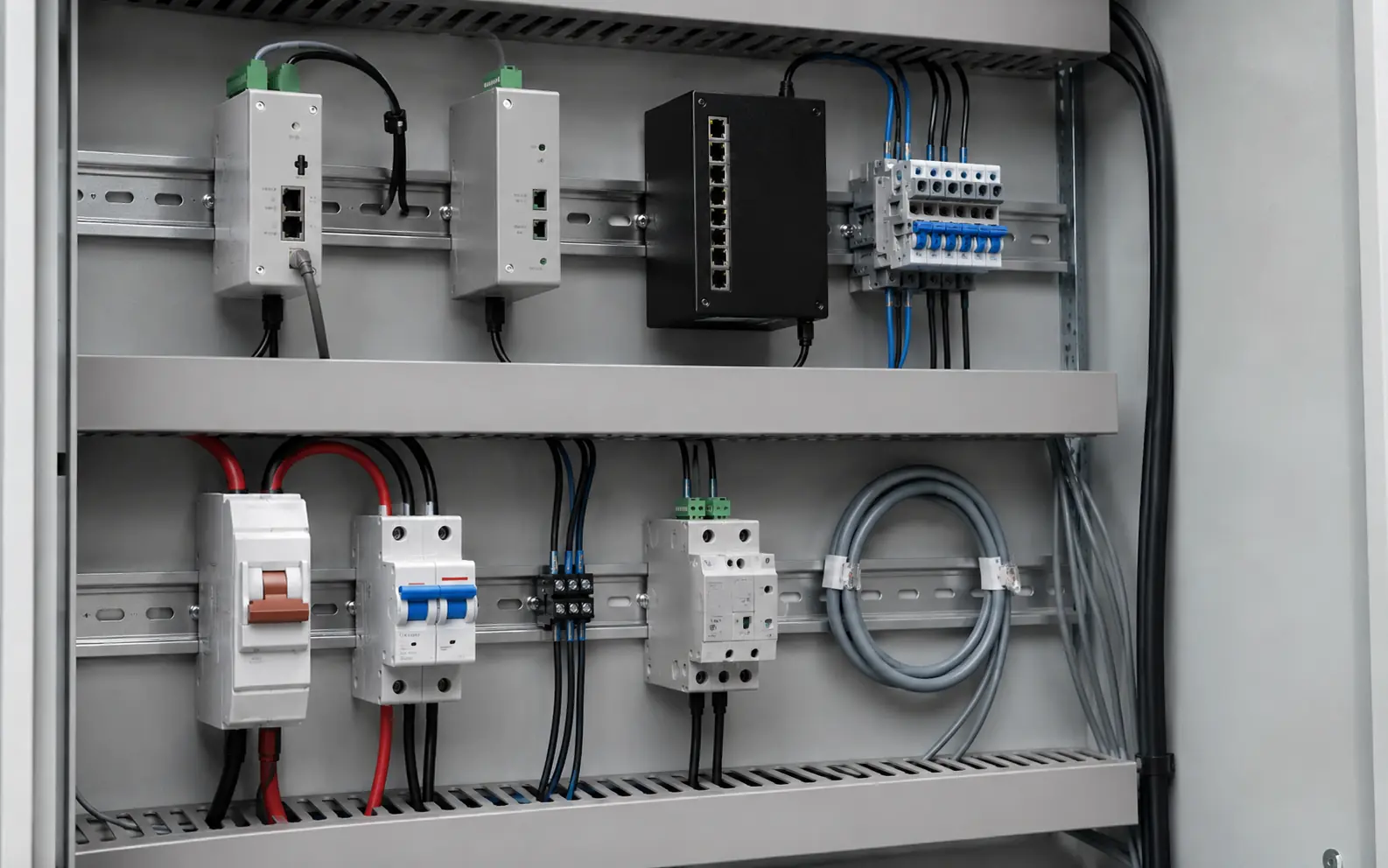
TPDIN® remote monitoring and control products provide DIN-rail options for monitoring voltage, current, temperature and other system parameters, along with relay control and network-based management.
Power Data Can Become Part of the Automation Strategy
At remote sites, battery voltage, charging current, temperature, equipment status, and communications availability can provide useful context for the automation system itself. Monitoring those conditions can help operators distinguish between an equipment problem, communications issue, and changing power condition before dispatching personnel.
Explore TPDIN® Monitoring & Control →Industrial Applications for Solar-Powered Automation
Utility and Infrastructure Monitoring
Water systems, electrical infrastructure, transportation equipment, pipelines, tanks, pumping systems, and other distributed assets may require remote sensors, controls, and communications without convenient local electrical service.
Industrial IoT and Telemetry
Industrial IoT systems use distributed sensors and communications equipment to collect operating data from assets in the field. Local solar and battery power can support those devices without requiring utility service at every measurement point.
Oil, Gas, Pipeline and Process Monitoring
Pipeline, tank, valve, flow, pressure, and process-monitoring equipment may be installed across large areas. Remote power can support sensing, telemetry, communications, and selected control equipment where another dependable power source is not readily available.
Transportation Infrastructure
Traffic monitoring, roadside sensors, communications equipment, cameras, signage controls, and other intelligent transportation devices may be located away from practical utility connections.
Agriculture and Environmental Automation
Soil sensors, weather stations, irrigation controls, environmental instruments, telemetry equipment, and related automation devices can operate at remote agricultural and research sites using appropriately sized solar and battery systems.
Designing for Industrial Reliability
Industrial equipment often operates in locations where a loss of power means lost data, interrupted communications, or reduced control visibility. Reliability therefore needs to be designed into the complete system rather than assumed from individual component specifications.
Important considerations include:
- Actual continuous and peak equipment load
- Seasonal solar availability
- Required battery autonomy
- Operating temperature
- Equipment voltage requirements
- Outdoor enclosure and mounting
- Surge and electrical protection
- Communications and monitoring
- Future equipment expansion
Size the Power System Around the Automation Load
Start with the equipment wattage, operating hours, site location, available sunlight, and required battery reserve. Tycon Systems® power and solar calculators can help establish the initial requirements before selecting the final hardware.
Use the Power & Solar Calculators →When a Complete Remote Solar System Makes Sense
Engineers and integrators can build remote power systems from individual panels, batteries, controllers, enclosures, and converters when the complete electrical and mechanical requirements are already defined.
Other projects benefit from using a preconfigured system where the major power components are already selected to operate together.
RemotePro® off-grid solar power systems combine solar generation, battery storage, charge control, weatherproof enclosures, and mounting for sensors, telemetry, communications equipment, wireless networks, cameras, and other remote industrial electronics.
What if the Industrial Site Already Has Primary Power?
Not every industrial automation application needs off-grid solar. Some field equipment already has utility, AC, PoE, or another primary power source but needs to remain online when that source is interrupted.
In those applications, UPSPro® outdoor UPS and battery backup systems provide a more appropriate path by supplying battery-backed power for network, monitoring, communications, and other critical field equipment.
The Future of Solar-Powered Industrial Automation
The most important change is not that solar will replace every industrial power source. It is that automation and monitoring equipment can increasingly be deployed in locations where conventional electrical infrastructure would previously have limited the project.
Better batteries, charge controllers, communications, monitoring, DC power conversion, and modular system design are making distributed field systems easier to integrate and manage.
As industrial IoT, remote telemetry, predictive maintenance, edge computing, and distributed sensing continue to expand, the ability to provide dependable power at the edge will remain an important part of industrial automation design.
Solar Power and Industrial Automation FAQs
Can solar power PLCs and industrial controllers?
Yes, when the complete solar and battery system is properly sized for the controller's voltage, energy consumption, operating schedule, environmental conditions, and required autonomy.
Can solar power industrial IoT sensors continuously?
It can when solar generation and battery storage are designed around the sensor, communications equipment, supporting electronics, available sunlight, and required runtime. Continuous operation should be treated as a sizing requirement rather than assumed automatically.
What industrial equipment can RemotePro® power?
Depending on the selected system and load, applications can include sensors, telemetry equipment, wireless radios, cellular routers, cameras, monitoring electronics, controllers, and other DC or PoE field equipment.
Why is remote monitoring useful in an off-grid automation system?
Monitoring can provide visibility into battery condition, charging, temperature, equipment state, and other system information before personnel are sent to a remote site.
Should industrial automation use RemotePro® or UPSPro®?
RemotePro® is the better starting point when the field site does not have dependable utility power and needs a complete solar-powered system. UPSPro® is intended for applications that already have a primary power source but need battery backup during interruptions.
Start With the Equipment and Site Requirements
If you're matching PLCs, sensors, communications equipment, solar capacity, battery storage, runtime, monitoring, mounting, and environmental conditions, Tycon Systems® can help develop a remote power configuration around the project.
Request a System Design → Explore RemotePro®