

How Solar Powers Security and Surveillance Systems
How Solar Powers Security and Surveillance Systems
Security cameras are increasingly installed where utility power is unavailable, unreliable, or expensive to extend. Construction sites, gates, equipment yards, farms, transportation corridors, utilities, industrial facilities, remote properties, and temporary monitoring locations may all need surveillance without a convenient AC outlet nearby.
Solar power can solve that problem, but a reliable solar surveillance system requires more than connecting a camera to a panel. The complete design needs to account for camera power, PoE, wireless or cellular communications, nighttime operation, battery autonomy, seasonal sunlight, temperature, and the environmental conditions at the site.
How Does a Solar-Powered Security Camera System Work?
In a properly designed off-grid surveillance system, the solar array generates energy during daylight and the battery stores enough energy to support the equipment when sunlight is unavailable.
A typical system may include:
- One or more solar panels
- Battery storage
- Solar charge controller
- Outdoor enclosure
- IP security cameras
- PoE injector or PoE switch
- Cellular router or wireless radio
- Surge protection where appropriate
- Monitoring or control equipment where required
The key is sizing those components as one system rather than treating the camera, communications hardware, battery, and solar array as independent pieces.
Do Not Size the Solar System From the Camera Alone
The camera may be only part of the electrical load. A cellular router, wireless radio, PoE switch, IR illuminator, heater, edge processor, recorder, or other network device can significantly increase daily energy consumption.
Calculate Camera and Network Power Consumption
Start by identifying every device that will receive power from the solar system.
For each device, determine:
- Operating voltage
- Typical power consumption
- Maximum power consumption
- Hours of operation per day
- PoE requirement where applicable
- Any nighttime or cold-weather increase in power
A camera rated at relatively low daytime power may draw more energy when infrared illumination, heaters, pan-tilt-zoom motors, or other features are operating.
For a 24-hour surveillance system, calculate energy use in watt-hours per day rather than looking only at instantaneous watts.
Battery Storage Keeps Surveillance Running at Night
Solar panels do not power a 24-hour camera system by themselves. Battery storage supports the surveillance equipment overnight and during periods when solar production is lower than the load.
Battery capacity should be selected around daily energy consumption, desired autonomy, battery chemistry, allowable depth of discharge, operating temperature, system losses, and expected aging.
Critical surveillance sites may justify more reserve than applications where an occasional interruption is acceptable.
Design for Cloudy Days, Not Just Perfect Weather
A surveillance system should not be sized around the best solar day of the year.
Consider:
- Seasonal Peak Sun Hours
- Cloudy weather
- Panel orientation
- Trees, structures and seasonal shading
- Snow accumulation
- Battery temperature
- Required recovery time after a low-sun period
The Tycon Systems® power and solar calculators can help establish the starting solar and battery requirements for a remote camera installation.
Power over Ethernet Simplifies Remote Camera Wiring
Many IP cameras receive power through Ethernet. PoE can simplify field installations by carrying electrical power and network data through the same Ethernet cable.
The PoE equipment still needs to be correctly matched to the camera. Verify whether the camera uses passive PoE or an IEEE standard such as 802.3af, 802.3at, or 802.3bt, along with its voltage and maximum power requirement.
Tycon Power® PoE switches provide DC-powered options designed for cameras, wireless equipment, access points, and remote network installations.
Communications Equipment Is Part of the Power Budget
A camera located away from wired infrastructure usually needs another way to move video and management traffic back to the operator.
Common options include:
- Cellular routers
- Point-to-point wireless bridges
- Wireless access points
- Licensed or unlicensed radios
- Existing Ethernet or fiber where available
The router or radio may operate continuously, so its power requirement needs to be included in the solar and battery calculation along with the cameras.
A Complete Solar Camera System in One Architecture
For projects where the cameras, cellular connectivity, PoE, remote monitoring, solar generation, and battery storage all need to be selected together, an integrated system can reduce the amount of component matching required by the installer.
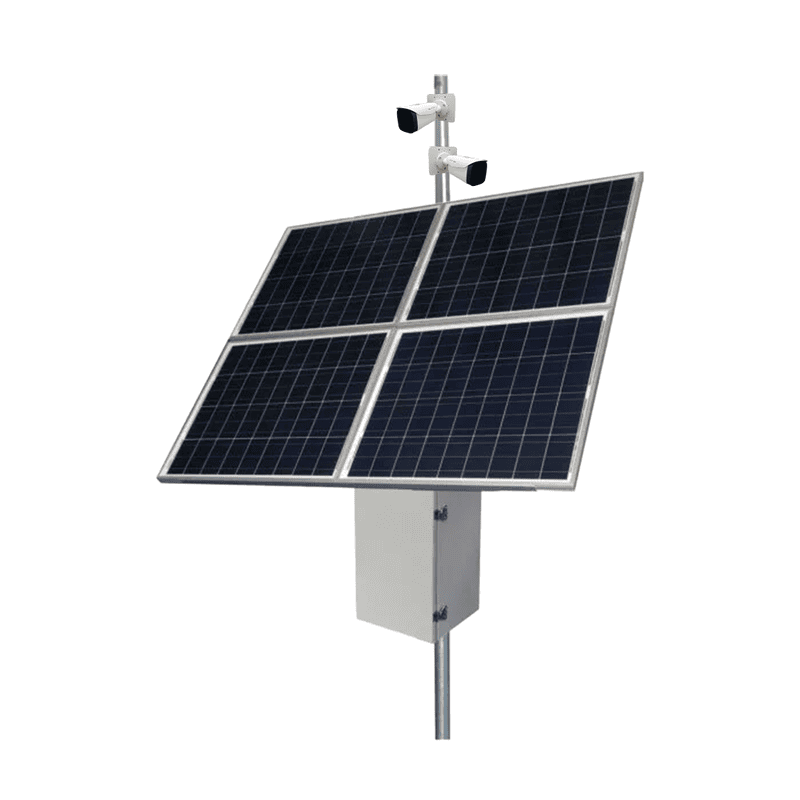
The current RCP-200-340-2C RemoteCameraPro™ includes a RemotePro® power system, LTE cellular router, two 8MP IP cameras, WEB3 remote monitor/control hardware and a Gigabit 802.3at PoE switch.
RemotePro® for Fixed Off-Grid Camera Sites
When the cameras and communications equipment are already selected, RemotePro® provides the underlying off-grid power architecture.
RemotePro® systems combine solar generation, battery storage, charge control, outdoor enclosure protection and mounting for cameras, radios, sensors and other field equipment.
Explore RemotePro® off-grid solar power systems →
Fixed Solar, Mobile Solar, or Battery Backup?
No dependable utility power at a fixed camera site?
Start with RemotePro®.
Need cameras, cellular communications and off-grid power as one package?
Consider RemoteCameraPro™.
Need the surveillance system to move?
Start with MobileSolarPro®.
Already have primary AC, DC or PoE power but need outage protection?
Start with UPSPro®.
MobileSolarPro® for Temporary and Movable Surveillance
Construction projects, parking lots, temporary facilities, events and changing security perimeters may need cameras that can move rather than remain permanently installed.
MobileSolarPro® trailer and skid platforms combine transportable solar generation, battery storage, mast capability, power electronics and PoE options for temporary surveillance and remote field equipment.
Explore MobileSolarPro® solar trailers and skids →
UPSPro® Is for Backup, Not Primary Off-Grid Solar
A security site that already has AC, DC, or PoE power has a different requirement from a truly off-grid site.
If the goal is to keep cameras or networking equipment operating during a primary-power interruption, an outdoor battery-backup system is usually the more appropriate architecture.
UPSPro® outdoor UPS and battery backup systems are intended for those applications rather than serving as the battery-management component inside a RemotePro® solar system.
Remote Monitoring Can Reduce Blind Spots in the Power System
Remote surveillance is easier to manage when operators can see more than the camera video.
Depending on the selected hardware, useful power-system information can include:
- Battery voltage
- Solar charging information
- Load current
- Temperature
- Equipment status
- Remote relay control or reboot functions
Monitoring capabilities depend on the selected system. RemotePro® itself should not be treated as a universal monitoring service; compatible products such as TPDIN® or WEB3-based configurations can provide remote visibility and control where required.
Protect Outdoor Ethernet and PoE Connections
Remote cameras often create long outdoor Ethernet cable runs, making electrical protection another important part of the installation.
Grounding, cable routing, shielded cabling where appropriate and surge protection should be considered according to the installation environment and equipment requirements.
This is especially important for equipment mounted on poles, towers, exposed structures or other locations where outdoor cable extends away from the protected electronics enclosure.
Common Solar Surveillance Applications
Construction Sites
Cameras can be installed before permanent utility infrastructure is available and moved or expanded as the project changes.
Equipment Yards and Remote Gates
Solar can support cameras, cellular communications and access equipment at remote entrances, storage areas and perimeter locations.
Agriculture and Ranches
Cameras can monitor livestock, equipment, gates, buildings, tanks and other assets across large properties where extending utility power to every location would be impractical.
Utilities and Critical Infrastructure
Remote substations, water systems, communications facilities and other distributed assets may require surveillance at locations far from conventional buildings.
Transportation and Roadside Monitoring
Cameras and communications equipment can support traffic, construction and transportation monitoring without requiring a permanent electrical service at every location.
Parking Lots and Commercial Properties
Solar and mobile surveillance can add coverage to areas where trenching or extending electrical service would be disruptive, expensive or temporary.
Reliable Surveillance Is an Energy-Balance Problem
A system needs enough solar energy to replace what the cameras and communications equipment consume, plus enough battery reserve to bridge nighttime and expected periods of poor solar production. A larger panel alone cannot compensate for inadequate storage, and a larger battery cannot compensate indefinitely for insufficient solar generation.
Solar Security System FAQs
Can security cameras run completely from solar power?
Yes, when solar generation, battery storage and supporting power equipment are properly sized for the complete camera and communications load at the installation location.
How do solar cameras work at night?
The cameras operate from battery energy stored during periods of solar production. Battery capacity needs to support nighttime operation plus the required reserve for poor-sun conditions.
How much solar power does an IP camera need?
There is no single wattage that fits every camera. Calculate the camera's daily energy consumption along with routers, radios, PoE switches, heaters, IR illumination and other equipment, then account for the solar resource at the site.
Can PoE cameras run from a battery system?
Yes. Appropriately selected DC-powered PoE injectors or switches can convert and deliver battery-based power to compatible PoE cameras.
How can a remote camera connect to the internet?
Cellular routers are common when wired internet is unavailable. Point-to-point wireless links and other network technologies can also be used depending on the site.
What happens during several cloudy days?
Battery storage supports the equipment when solar production is insufficient. The amount of reserve required should be determined from the site's expected conditions and the importance of uninterrupted surveillance.
Should I use RemotePro® or MobileSolarPro®?
RemotePro® is the natural starting point for a fixed off-grid camera installation. MobileSolarPro® is intended for applications where the solar, battery and surveillance platform needs to move between sites.
When should I use UPSPro® instead?
Use UPSPro® when the camera or network equipment already has a normal AC, DC or PoE power source and the main requirement is battery backup during an interruption rather than primary off-grid solar generation.
Start With the Cameras, Communications Equipment and Location
Tycon Systems® can help match camera load, PoE requirements, cellular or wireless equipment, solar generation, battery storage, mounting and environmental conditions to a fixed or mobile surveillance deployment.
Request a System Design → Explore RemotePro®