

Comparing Tycon Solar® Power Kits for Different Applications
Comparing Tycon Solar® Power Kits for Different Applications
A solar power kit can simplify the generation side of a remote power project by combining the solar panel, charge controller, mounting hardware, and outdoor cable into a matched package. The right kit, however, still depends on the equipment being powered, system voltage, available sunlight, battery requirements, and installation site.
Tycon Solar® TPSK solar kits cover a range of power levels for wireless equipment, surveillance, lighting, monitoring, communications, and other remote applications. Understanding the differences between the kits helps installers choose the appropriate solar capacity without oversizing or undersizing the system.
What Is Included in a Tycon Solar® TPSK Solar Kit?
The TPSK series is designed to provide the main solar-generation components needed for a battery-based remote power system.
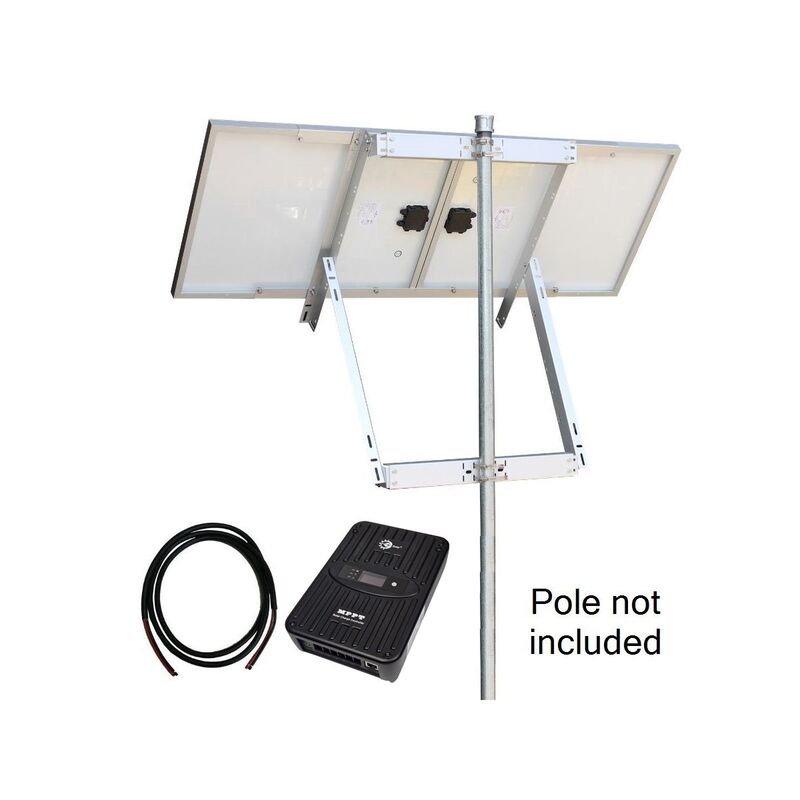
Depending on the model, a kit typically includes:
- One or more solar panels
- PWM or MPPT solar charge controller
- Side-of-pole or wall mounting hardware
- Outdoor-rated solar cable
A Solar Kit Is Not Automatically a Complete Off-Grid Power System
TPSK solar kits provide the solar-generation and charging hardware. Battery storage, outdoor equipment enclosures, DC conversion, PoE power, and other system components may still be required. If you need the solar array, battery bank, charge control, enclosure, and mounting designed together, a RemotePro® system may be the better starting point.
Start With the Equipment Load
Solar-kit selection should begin with the equipment being powered rather than simply choosing the largest available panel.
Determine:
- Equipment operating voltage
- Continuous power consumption
- Peak or startup power where applicable
- Hours of operation per day
- Site location and available sunlight
- Battery autonomy requirement
- Expected seasonal and environmental conditions
A device drawing only a few watts can still require substantial daily energy when it operates continuously. For that reason, daily watt-hours are generally more useful than instantaneous wattage when sizing a remote solar system.
Estimate the Solar Requirement Before Choosing a Kit
Tycon Systems® provides power and solar calculators that can help estimate the energy required by the equipment and the solar capacity needed at the installation location.
Use the Power & Solar Calculators →Comparing Solar Kits by Power Level
The current Tycon Solar® TPSK range includes compact kits for smaller loads as well as larger MPPT-based systems for higher-energy applications.
The correct kit depends on actual daily energy consumption and available sunlight. The application examples below are useful starting points rather than fixed wattage rules.
30W–35W Solar Kits
Smaller kits are useful for low-power applications where daily energy consumption is modest. Current configurations include 12V and 24V options.
Potential applications can include:
- Low-power sensors
- Telemetry equipment
- Compact wireless radios
- Small monitoring loads
50W Solar Kits
A 50W kit provides additional solar capacity while remaining compact enough for many pole-mounted applications. Both 12V and 24V configurations are available.
These kits may be appropriate for:
- Wireless networking equipment
- Remote sensors and telemetry
- Low-power cameras
- Remote monitoring electronics
100W Solar Kits
The 100W range provides more charging capacity for applications with higher continuous loads or sites where additional solar energy is required.
Applications can include:
- IP cameras
- Wireless bridges
- Cellular routers
- Environmental monitoring
- Multiple low-power devices
200W Solar Kits
The TPSK12/24M-200W uses two 100W solar panels and a 12/24V auto-detect MPPT solar charge controller. It is intended for applications requiring significantly more charging capacity than the smaller single-panel systems.
Potential applications include:
- Higher-power surveillance equipment
- Multiple cameras or radios
- Wireless base stations
- Industrial monitoring systems
- Larger battery banks requiring greater charging capacity
400W Solar Kits
The larger 400W TPSK configuration uses four 100W panels and is intended for installations requiring substantially greater daily solar production.
Larger systems can be useful for:
- Multi-device remote sites
- Higher-power communications equipment
- Industrial monitoring and control loads
- More demanding surveillance installations
- Applications requiring faster battery recovery
Browse the current Tycon Solar® Solar Kits to compare available wattage, voltage, controller, and mounting configurations.
PWM vs. MPPT Solar Kits
Controller type is another important difference between solar-kit configurations.
PWM controllers can be practical in smaller systems where solar-panel voltage and battery voltage are appropriately matched. MPPT controllers provide greater flexibility when higher array voltages or larger solar configurations are required.
The controller should always be selected around battery voltage, battery chemistry, solar-array voltage, charging current, and cold-weather panel open-circuit voltage rather than by controller type alone.
Choosing a Solar Kit for Wireless Networking
Wireless bridges, access points, cellular routers, and radios are common remote solar loads. Some consume only a few watts, while larger wireless systems may include multiple radios, switches, routers, or PoE equipment.
Calculate the combined continuous load before selecting the kit. A small radio may work with a compact solar configuration, while a multi-device network site may require substantially more solar and battery capacity.
Choosing a Solar Kit for Surveillance
Surveillance systems often operate continuously and may include more than the camera itself. IR illuminators, heaters, wireless radios, cellular routers, PoE equipment, and edge-processing hardware can all increase daily energy consumption.
Solar and battery capacity should therefore be based on the complete security-system load rather than only the camera specification.
Choosing a Solar Kit for Industrial Monitoring
Sensors, data loggers, industrial controllers, telemetry equipment, cellular gateways, and monitoring systems are frequently installed at utility, agricultural, environmental, and industrial field sites.
These loads may be relatively small but continuous. Battery autonomy and seasonal solar availability can therefore be just as important as the equipment's instantaneous wattage.
Choose the Product Type Based on What You Already Have
Already have the battery, enclosure, and power architecture? A TPSK solar kit may provide the generation, charging, cable, and mounting hardware you need.
Need a complete off-grid solar and battery system? Start with RemotePro®.
Already have primary power but need outdoor battery backup? Start with UPSPro® rather than an off-grid solar system.
When RemotePro® Is the Better Choice
A solar kit is useful when the rest of the power system has already been defined. If the project still needs the battery bank, outdoor enclosure, charge control, wiring, mounting, and overall power architecture selected together, a complete system can simplify the design process.
RemotePro® off-grid solar power systems are designed around complete remote installations for cameras, wireless equipment, sensors, telemetry, communications systems, and other field electronics.
When UPSPro® Is the Better Choice
If the site already has AC, DC, or PoE as its normal power source, the primary requirement may be backup rather than off-grid generation.
UPSPro® outdoor UPS and battery backup systems are designed to keep network, communications, monitoring, and other field equipment operating when the normal power source is interrupted.
Solar Power Kit FAQs
What does a Tycon Solar® TPSK kit include?
Current TPSK kits combine solar panel capacity with a solar charge controller, mounting hardware, and outdoor-rated cable. Exact components vary by model, so the individual product specification should always be checked.
Does a TPSK solar kit include batteries?
The current TPSK solar-kit configurations should not be assumed to include battery storage. Batteries are selected separately unless the individual product listing specifically states that they are included.
How do I know how many watts of solar I need?
Start with daily equipment energy consumption, available sunlight, system losses, battery capacity, seasonal conditions, and desired battery-recovery time. Solar-panel wattage alone is not enough to determine whether a system is properly sized.
Should I choose a 12V or 24V solar kit?
The solar kit and controller need to match the battery-system architecture and connected equipment. Some larger Tycon Solar® kits support both 12V and 24V battery systems using auto-detect MPPT charge controllers.
Is MPPT always better than PWM?
No. MPPT provides useful flexibility in many larger or higher-voltage configurations, while PWM remains appropriate for properly matched smaller systems. The correct choice depends on the panel, battery, voltage, power level, and application.
Can a Tycon Solar® kit power a security camera?
Yes, if the kit, battery storage, and supporting power hardware are properly sized for the complete camera-system load and the solar conditions at the site.
What if I am not sure which kit to use?
Start by documenting the equipment voltage, wattage, operating schedule, installation location, and desired battery autonomy. Those requirements make it much easier to determine whether a TPSK solar kit or complete RemotePro® system is the better solution.
Start With the Load, Battery and Site
Tycon Systems® can help match the equipment load, system voltage, solar capacity, battery storage, controller, mounting, and environmental requirements to the application.
Request a System Design → Compare Solar Kits