

Tycon Systems Heading to ISC West Las Vegas – March 25–27
Tycon Systems Heading to ISC West Las Vegas – March 25–27
In March 2026, Tycon Systems® attended ISC West in Las Vegas, bringing remote power, solar, battery backup, mobile solar, and network-power solutions to one of the security industry's major technology events.
For security integrators, surveillance professionals, network installers, and infrastructure engineers, reliable power is often one of the most important parts of a remote deployment. Cameras, wireless radios, cellular routers, switches, access-control equipment, and monitoring systems may need to operate in locations where utility power is unavailable, unreliable, or impractical to extend.
Remote Power Is Part of Modern Security Infrastructure
Security systems are increasingly deployed outside traditional buildings. Cameras and communications equipment can now be found along highways, construction sites, utility infrastructure, agricultural properties, industrial facilities, remote gates, temporary locations, and large distributed sites.
In these applications, the camera is only one part of the installation. The complete system may also need wireless communications, network switching, cellular connectivity, battery storage, surge protection, voltage conversion, and an outdoor enclosure.
Power therefore needs to be considered as part of the security-system design from the beginning rather than after the surveillance equipment has already been selected.
The Right Security Power Solution Depends on What Power Is Available
A surveillance site with no utility power has different requirements from a location that already has AC or PoE but needs battery backup. Temporary or rapidly deployable surveillance can require a different approach again. Matching the power architecture to the site helps avoid oversizing, undersizing, and unnecessary complexity.
Off-Grid Solar Power for Remote Cameras
When grid power is not available, a solar and battery system can generate and store energy directly at the surveillance location.
The system needs to be sized around the complete equipment load, including the camera, wireless equipment, router, switch, heater, illuminator, or other connected electronics. Daily energy use, available sunlight, battery autonomy, temperature, and seasonal conditions all affect the final configuration.
RemotePro® off-grid solar power systems combine solar generation, battery storage, charge control, outdoor enclosures, and mounting for cameras, wireless networks, sensors, communications equipment, and other remote electronics.
Battery Backup Where Primary Power Already Exists
Not every remote security installation needs solar. Some sites already have AC, DC, or PoE power but need cameras and communications equipment to remain operational during interruptions.
For those applications, UPSPro® outdoor UPS and battery backup systems provide a more appropriate starting point by combining battery backup with outdoor protection and power management for field equipment.
Mobile Solar Power for Temporary Surveillance
Construction sites, temporary facilities, events, parking areas, emergency operations, and changing security perimeters may require surveillance equipment that can be moved rather than permanently installed.
Mobile platforms can combine solar generation, battery storage, equipment enclosures, network connectivity, and elevated camera mounting in one deployable system.
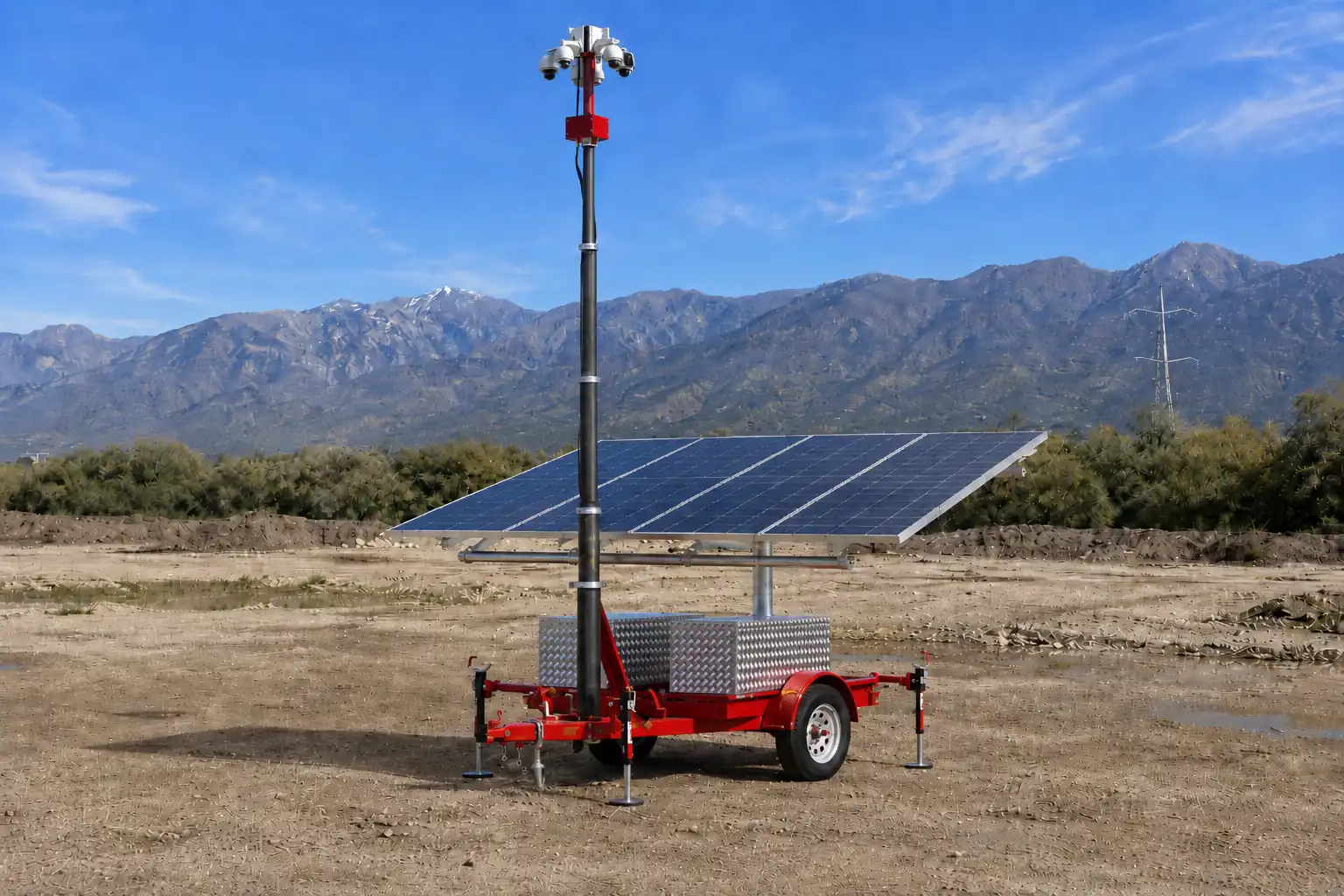
MobileSolarPro® solar trailers and skids provide portable off-grid power platforms for cameras, radios, lighting, communications equipment, and other temporary or movable loads.
Power over Ethernet for Cameras and Network Equipment
Power over Ethernet is an important part of many modern security systems because a single Ethernet cable can carry both network data and electrical power to a camera, radio, access point, or other network device.
Remote and battery-powered systems often need to convert available DC voltage into the PoE voltage required by the connected equipment. Other installations may need AC-powered injectors, multiport solutions, or higher-power IEEE PoE.
Explore Tycon Power® PoE injectors and power inserters for cameras, wireless devices, access points, routers, and other network equipment.
Match the Power Platform to the Deployment
No dependable utility power? Start with RemotePro®.
Primary power is available but backup is required? Start with UPSPro®.
Need movable or temporary surveillance? Consider MobileSolarPro®.
Need to deliver power and data to cameras or radios? Match the system with the appropriate Tycon Power® PoE equipment.
Security Applications Discussed at ISC West
Construction Site Surveillance
Construction sites often need cameras before permanent utility infrastructure is available. Solar and mobile power systems can support surveillance and communications during different phases of the project.
Transportation Monitoring
Roads, rail corridors, parking areas, and transportation assets may require cameras, wireless links, sensors, or communications equipment at locations far from conventional electrical service.
Critical Infrastructure
Utilities, water systems, telecommunications sites, pipelines, substations, and other distributed assets often need security monitoring and communications across geographically separated locations.
Remote Gates and Perimeters
Cameras, access-control devices, wireless links, and cellular communications can be installed at gates and perimeter locations where the nearest electrical service may be a significant distance away.
Smart City and Distributed Monitoring
Distributed cameras, sensors, communications devices, and edge equipment create additional power requirements throughout municipalities and large infrastructure networks. Remote power can make selected installations possible without extending conventional electrical infrastructure to every device.
Why System Sizing Matters for Surveillance
Security equipment may operate continuously, and many camera systems include supporting devices that significantly increase total energy consumption.
A useful load calculation should include:
- Camera power consumption
- IR illuminators or heaters
- Wireless radios
- Cellular routers
- PoE switches and injectors
- Recording or edge-computing equipment
- Future expansion
Calculate the Power Requirement Before Selecting the System
Start with the complete equipment load, operating time, site location, available sunlight if solar is required, and desired battery reserve. Tycon Systems® power and solar calculators can help establish the initial requirements.
Use the Power & Solar Calculators →What ISC West Reinforced About Remote Security
Security technology continues to move farther from traditional buildings and closer to the assets that need to be monitored. Cameras, edge devices, wireless communications, analytics, and sensors increasingly operate across distributed environments.
That makes power infrastructure part of the security architecture itself. A capable camera or wireless network still depends on having the correct voltage, sufficient energy storage, appropriate environmental protection, and a reliable way to deliver power to the equipment.
ISC West provided an opportunity for Tycon Systems® to discuss those real deployment challenges directly with integrators and security professionals.
Start With the Camera, Network and Site
Tycon Systems® can help match cameras, radios, routers, PoE equipment, solar generation, battery capacity, backup power, mounting, and environmental requirements to the deployment.
Request a System Design → Explore MobileSolarPro®