World Marketing Day 2026: B2B Solar Marketing | Tycon®
World Marketing Day, observed on May 27, is a useful reminder that effective marketing begins with understanding what customers are actually trying to accomplish.
That principle is especially important in technical B2B markets. Engineers, integrators, operations managers, installers, and procurement teams rarely begin a project by searching for a proprietary product family or model number. They begin with a problem: a camera has no available power, a wireless network needs battery backup, a sensor must operate miles from the grid, or a temporary site needs power that can move with the project.
For manufacturers, distributors, resellers, and integrators selling solar and remote-power equipment, good marketing connects that real-world problem to the appropriate technical solution. World Marketing Day 2026 is an opportunity to look at how technical products can be explained more clearly, supported with stronger evidence, and presented in language customers actually use.
Technical Marketing Should Start With the Customer's Problem
A model number may be important after a customer understands what they need, but it is rarely the beginning of the buying process.
Customers are more likely to describe their requirements in language such as:
- I need solar power for a security camera.
- I need backup power for an outdoor wireless access point.
- I need to power a sensor where utility power is unavailable.
- I need PoE from a 12V or 24V battery system.
- I need a surveillance platform that can move between construction sites.
- I need to keep network equipment online during power interruptions.
Effective B2B marketing answers those questions first and then introduces the appropriate product family.
Problem → Solution → Product Family → Specific Model
A technical buyer should be able to understand what type of solution they need before being asked to compare model numbers. Product specifications become much more useful once they are connected to a real application.
Sell the Difference Between Off-Grid Power and Backup Power
Technical marketing loses credibility when different power architectures are described as if they solve the same problem.
For example, RemotePro® and UPSPro® are both remote-power families, but they should not be marketed interchangeably.
RemotePro®: No Dependable Primary Power
RemotePro® off-grid solar power systems are designed for cameras, wireless equipment, sensors, telemetry, and other remote electronics where dependable grid power is unavailable.
UPSPro®: Primary Power Exists but Needs Backup
UPSPro® outdoor UPS systems provide battery backup for cameras, wireless networks, communications equipment, sensors, and other critical electronics when an existing AC, DC, or PoE power source is interrupted.
Marketing that explains this distinction is more useful than simply listing battery capacities, voltages, or enclosure sizes without explaining why a customer would choose one architecture over another.
Translate Features Into Operational Meaning
Technical specifications matter. Engineers need them. Installers need them. Procurement teams may require them.
But specifications become more persuasive when buyers understand what they mean for the application.
400W solar array
Feature: solar-generation capacity.
Meaning: part of the energy budget available to recharge the battery system.
1200Wh battery storage
Feature: stored energy.
Meaning: contributes to how long the equipment can operate without sufficient charging input.
802.3at PoE output
Feature: standardized network power.
Meaning: can power compatible cameras, radios, access points, and other Ethernet devices.
Outdoor enclosure
Feature: protected hardware location.
Meaning: batteries and electronics can be deployed where the field equipment actually operates.
Good technical marketing keeps the specification and explains its purpose. It should not replace engineering information with vague promises.
Show the Product Doing the Job
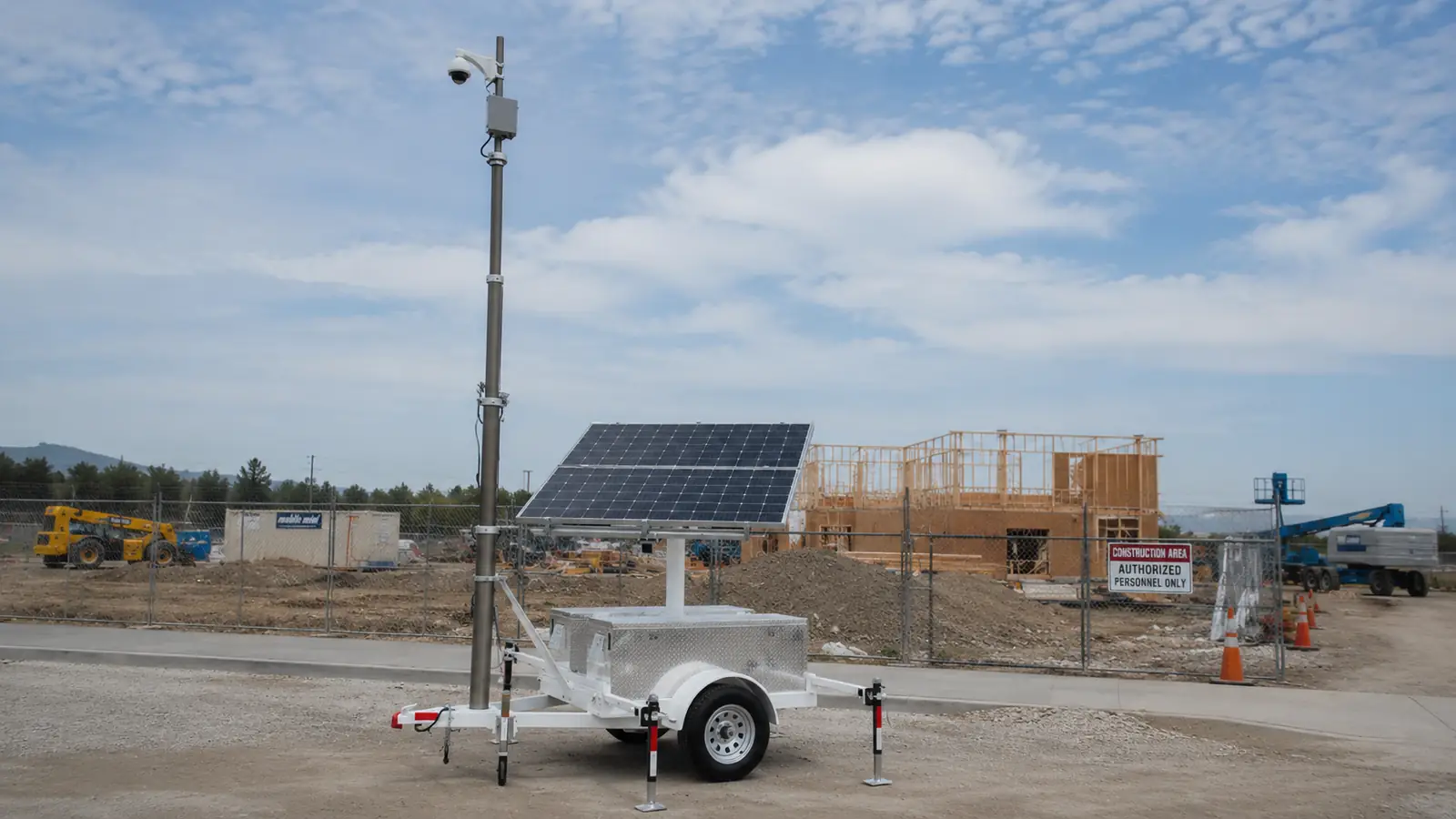
Remote-power products often make more sense in an application photograph than they do against a white background.
A buyer looking at a solar trailer deployed beside a construction project can immediately understand mobility, camera elevation, solar generation, battery storage, and temporary site coverage.
Use Case Studies as Technical Proof
B2B buyers often need evidence that a solution has been used in an environment similar to their own.
A good case study should explain the problem, the installation constraints, the equipment used, and the result without exaggerating what the product actually did.
For example, a mobile-surveillance deployment can demonstrate how RemotePro® provided off-grid power for cameras and cellular communications. A port installation can demonstrate how UPSPro® provided battery backup for wireless network equipment.
Tycon Systems® maintains a collection of real-world deployments covering remote power, surveillance, communications, industrial applications, research, and backup power.
Answer the Questions Customers Search Before They Call
Search-focused content works best when it reflects the language customers use while evaluating a project.
Useful technical topics include:
- How much solar power does a remote camera need?
- How large should the battery bank be?
- MPPT vs. PWM solar charge controllers
- How long will an outdoor UPS run?
- Can PoE equipment operate from batteries?
- How do you power a wireless bridge off-grid?
- How can a camera operate without utility power?
- When is a mobile solar trailer better than a fixed system?
Educational content earns its place in the sales process when it genuinely helps the buyer make a better technical decision.
Teach First. Route to the Product Second.
A useful article should answer the technical question that brought the visitor to the page. Once that question is answered, connect the reader naturally to a relevant category, product, calculator, case study, system-design request, or support resource.
Make Product Families Easy to Explain
Distributors, resellers, integrators, and internal sales teams need a simple way to explain where each family fits.
Need primary off-grid solar power?
Start with RemotePro®.
Already have power but need battery backup?
Start with UPSPro®.
Need the entire solar platform to move?
Start with MobileSolarPro®.
Need PoE, DC conversion, switching, or network power?
Start with Tycon Power®.
This problem-first language is easier to remember and more useful to customers than requiring them to understand every Tycon® family name before they know which technology they need.
Do Not Market Monitoring Capabilities the Wrong Way
Monitoring is valuable, but technical marketing should identify where the capability actually comes from.
RemotePro® is an off-grid solar system family, not a universal monitoring platform. UPSPro® is an outdoor backup-power family, not a solar energy-management dashboard.
Selected charge controllers provide communications and operating information, while products such as TPDIN® WEB3 can provide voltage, current, temperature, relay control, alerts, and other remote-monitoring functions in compatible systems.
Accurate positioning builds more credibility than assigning every desirable feature to every product family.
Use Email to Solve One Problem at a Time
Technical email campaigns do not need to contain an entire product catalog.
A focused campaign can begin with one application:
- Power cameras where there is no grid connection.
- Keep outdoor WiFi online during an outage.
- Deploy surveillance before permanent infrastructure exists.
- Convert battery power into the PoE voltage a device requires.
- Monitor remote battery and power conditions without immediately visiting the site.
The email can then lead to the appropriate guide, category, case study, product, or engineering resource instead of attempting to explain every possible configuration at once.
Webinars Work Best When the Audience Leaves Knowing How to Decide
A technical webinar should give attendees a repeatable method they can use on the next project.
Strong webinar topics include:
- How to size solar and battery power from equipment wattage
- RemotePro® vs. UPSPro®
- Powering PoE equipment from solar and batteries
- Designing solar-powered surveillance systems
- Selecting MPPT or PWM charge controllers
- Planning mobile solar power for temporary sites
A product demonstration becomes more useful when viewers understand the engineering decision that led to that product.
Give Resellers and Integrators Better Sales Tools
Manufacturers do not control every conversation that happens around their products.
Distributors and resellers need concise descriptions, accurate specifications, useful images, application examples, current product links, and clear distinctions between product families so they can represent the technology correctly on their own websites and in customer conversations.
Tycon Systems® works with an international network of authorized resellers and stocking distributors , making clear product positioning especially important across multiple markets and sales channels.
Measure Marketing by What Qualified Visitors Do Next
Traffic, impressions, email opens, and social engagement can help diagnose a campaign, but they are not the final business objective.
For technical B2B marketing, useful downstream actions may include:
- Exploring a relevant product category
- Comparing specific system configurations
- Using a sizing calculator
- Reading a related deployment or case study
- Requesting a system design
- Requesting a quote
- Contacting technical support
- Beginning a reseller or distributor relationship
The best campaign is not necessarily the campaign with the most traffic. It is the one that helps the right audience move closer to solving a real problem.
Clarity Is a Competitive Advantage
Technical marketing does not need more hype. It needs a clearer connection between the customer's problem, the engineering requirement, the product category, and the evidence that the solution works.
World Marketing Day FAQs
When is World Marketing Day?
World Marketing Day is observed on May 27. The date was chosen in recognition of marketing educator and author Philip Kotler, who was born on May 27, 1931.
What works best when marketing technical solar products?
Begin with the customer's application, explain the engineering problem, provide enough technical information to evaluate the solution, and use real installations or case studies to demonstrate how the products are used.
Should B2B marketing emphasize features or benefits?
Both. Technical buyers need accurate specifications, but those specifications should also be translated into operational meaning. Avoid separating the benefit from the engineering requirement that makes it possible.
How should RemotePro® be marketed?
RemotePro® is a complete off-grid solar power family for cameras, wireless equipment, sensors, telemetry, monitoring hardware, and other remote electronics where dependable grid power is unavailable.
How should UPSPro® be marketed?
UPSPro® is primarily an outdoor battery-backup family for critical equipment that already has a normal AC, DC, or PoE power source but needs continued operation during power interruptions.
What content is useful for solar and remote-power buyers?
Sizing guides, troubleshooting articles, application guides, case studies, product comparisons, calculators, installation information, webinars, and clear technical documentation can all help buyers move from a problem toward the appropriate system.
How can Tycon® resellers market products more effectively?
Organize the message around customer applications, preserve accurate product specifications and family roles, use current Tycon® imagery and links, and connect technical content to the products that actually solve the application.
Start With What the Customer Needs to Power, Protect or Connect
Explore Tycon Systems® real-world deployments and remote-power families to see how off-grid solar, outdoor UPS, mobile power, PoE and connectivity products fit actual field applications.
Explore Real-World Deployments → Reseller & Distributor Resources