World Sun Day 2026: Solar Power in Action | Tycon®
World Sun Day 2026: Solar Power in Action | Tycon®
Every solar-powered camera, wireless radio, sensor station, communications site, and remote monitoring system begins with the same energy source: sunlight.
World Sun Day 2026 is a good opportunity to look beyond solar as an abstract renewable-energy technology and see what it actually does in the field. For Tycon Systems®, that means powering equipment in places where conventional electrical infrastructure may be unavailable, unreliable, temporary, or difficult to extend.
Why May 3 Is Associated With Solar Energy
The modern solar-energy observance traces back to 1978, when the United States designated May 3 as Sun Day. The goal was to increase public understanding of solar technology and demonstrate the potential of energy generated from sunlight.
Solar technology has changed dramatically since then, but the underlying question remains relevant: where can energy from the sun solve a practical power problem?
The Most Useful Solar System Is the One Designed Around the Load
Solar panels are only one part of an off-grid power system. Reliable operation also depends on battery capacity, charge control, equipment efficiency, available sunlight, temperature, mounting, wiring, and the actual energy consumed by the connected devices.
How Solar Panels Turn Sunlight Into Useful Field Power
Photovoltaic solar cells convert sunlight directly into DC electrical energy. That electricity can be used immediately or routed through a solar charge controller to recharge a battery bank.
For off-grid equipment that needs to operate around the clock, the battery is what allows the system to continue powering the load after sunset. The charge controller manages how energy from the solar array is delivered to the battery and, on some systems, how the connected load is managed.
Tycon Solar® offers solar panels for remote power applications ranging from compact battery-charging systems through larger off-grid installations.
Solar Power for Remote Security and Surveillance
Security cameras are a natural off-grid solar application because surveillance often needs to reach areas where electrical service does not.
Examples include:
- Construction sites
- Remote gates and entrances
- Equipment yards
- Transportation infrastructure
- Utility facilities
- Agricultural properties
- Remote industrial sites
A complete design needs to account for the cameras as well as PoE equipment, cellular routers, wireless links, switches, heaters, IR illumination, and any other device drawing energy from the battery system.
Solar Power for Wireless Communications
Wireless infrastructure frequently has to operate beyond convenient utility power. Point-to-point radios, wireless access points, repeaters, cellular routers, and network switches can all be supported by properly sized off-grid power.
Because many of these devices run 24 hours per day, even a modest continuous load can create a significant daily energy requirement.
Solar and battery capacity therefore need to be calculated from watt-hours of daily consumption rather than simply selecting a panel that appears large enough for the equipment's instantaneous wattage.
Solar Power for Industrial Sensors and IoT
Industrial IoT is creating more demand for sensors, gateways, telemetry, and communications equipment at the actual assets being monitored.
Solar can support applications such as:
- Environmental monitoring
- Tank and pipeline telemetry
- Water infrastructure
- Industrial sensors
- Cellular gateways
- Remote controllers
- Data acquisition equipment
Generating power beside the equipment can eliminate the need to extend conventional electrical infrastructure to every monitoring point.
Solar Panels in Action
The value of solar becomes much clearer when it is viewed as part of a complete field installation rather than as an isolated panel.
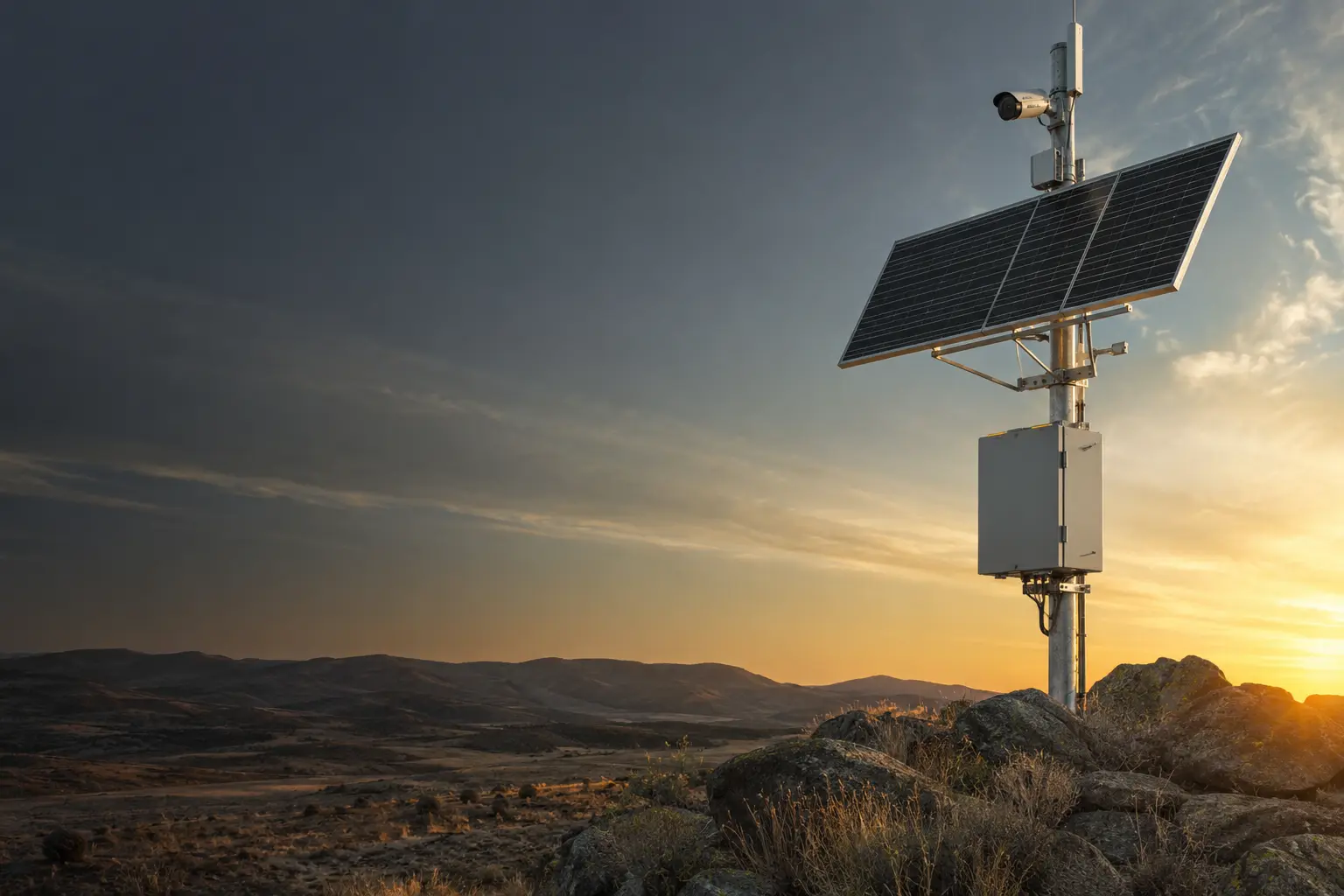
RemotePro®: Complete Off-Grid Solar Power
When a site has no dependable primary power source, RemotePro® is the primary Tycon Solar® family designed for the job.
RemotePro® systems combine solar generation, battery storage, solar charge control, weather-resistant enclosure hardware, mounting, cabling, and related power components for remote field equipment.
Current RemotePro® configurations support applications including cameras, wireless networks, sensors, communications equipment, telemetry, lighting, and other off-grid electronics. Explore RemotePro® off-grid solar power systems →
What About UPSPro®?
UPSPro® solves a different power problem.
It is primarily designed for outdoor equipment that already has a normal AC, DC, or PoE power source but needs battery backup when that primary source is interrupted.
Some UPSPro® systems are solar-ready or incorporate solar charging features, but the family should not be confused with RemotePro® when the project requires primary off-grid solar power.
MobileSolarPro® Takes Solar Power Where the Job Moves
Not every off-grid installation stays in one place.
Temporary surveillance, construction, communications, emergency response, lighting, events, and industrial field operations may need a solar and battery platform that can move as the project changes.
MobileSolarPro® trailers and skids combine solar generation, battery storage, field-ready outputs, mast options, monitoring, and equipment integration on transportable platforms.
A Mobile Solar System Can Follow the Application
When cameras, communications, lighting, or monitoring equipment needs to move between sites, transporting the energy source with the equipment can eliminate the need to rebuild temporary electrical infrastructure at every location.
Five Solar Facts Worth Knowing on World Sun Day
1. Solar Panels Produce DC Electricity
Photovoltaic panels naturally produce DC power. That makes solar especially well suited to battery-based remote systems and DC equipment when the voltages are properly matched.
2. A Small Continuous Load Adds Up Quickly
A device consuming only 10W continuously uses 240Wh every day. Add cameras, routers, radios, switches, heaters, or sensors and the daily energy requirement can grow quickly.
3. Solar Panel Voltage Changes With Temperature
Solar-panel voltage generally increases as cell temperature decreases. That is why cold-weather open-circuit voltage needs to be considered when panels are connected in series to an MPPT charge controller.
4. Batteries Make 24-Hour Solar Operation Possible
The battery stores energy generated during available sunlight and supplies it when the array is producing less energy than the connected equipment requires.
5. More Solar Panels Are Not Always the First Answer
Improving equipment efficiency, correcting shading, replacing a weak battery, adjusting system operation, or fixing an undersized conductor may sometimes improve the system without simply adding more solar capacity.
Solar Power vs. Generator Power at Remote Sites
Solar and generators should not be treated as universal competitors. Each can solve different power problems, and some remote systems benefit from using both.
Solar can be particularly useful when:
- The electrical load is relatively modest and predictable
- The site receives adequate solar energy
- Equipment needs to operate unattended
- Fuel delivery or generator service would be difficult
- Noise or engine operation is undesirable
A generator or hybrid system can still make sense when:
- Electrical loads are very large
- Energy demand changes significantly
- Extended poor-sun periods are expected
- Another charging source is required for redundancy
- Temporary high-power equipment needs to be supported
The best architecture depends on the load, location, operating requirements, service access, and the consequences of losing power.
Monitoring Helps Make Solar More Manageable
Remote solar systems become easier to support when operators can see what is happening without immediately traveling to the site.
Depending on the installed equipment, monitoring can provide information such as:
- Battery voltage
- Charge and discharge current
- Solar charging performance
- Equipment load
- Temperature
- Equipment or relay status
Tycon® TPDIN® monitoring and control products provide options for remote measurement and control in compatible power installations.
Solar Technology Continues to Improve
Advances in solar power do not depend on one dramatic technology change. Improvements continue across the entire system.
Important areas include:
- Higher-performing photovoltaic cells
- Improved MPPT charge controllers
- Better battery technology
- More efficient DC electronics
- Improved remote monitoring
- Lower-power cameras, sensors, and networking equipment
- Better integration between power and communications systems
For remote infrastructure, these incremental improvements can translate into smaller systems, longer runtime, better visibility, and more practical deployments.
Good Solar Design Starts With the Application
The goal is not to install the largest possible solar array. It is to understand the equipment load, available sunlight, battery reserve, environment, and operating requirements and build a system that matches the job.
World Sun Day FAQs
When is World Sun Day?
May 3 has been associated with solar-energy awareness since the original Sun Day observance in 1978. Today the date is commonly used to recognize solar energy, its applications, and the role sunlight can play in renewable power.
What equipment can be powered by off-grid solar?
Properly sized systems can power cameras, wireless radios, cellular routers, network equipment, sensors, telemetry, monitoring hardware, controllers, lighting, and many other DC or PoE field devices.
Can solar power operate equipment at night?
Yes. Batteries store energy generated during available sunlight and provide power when the solar array is not producing enough energy to support the load.
Can solar completely replace a generator?
In some applications it can. In others, a generator or another charging source may remain useful for unusually large loads, extended low-sun periods, redundancy, or backup. The correct answer depends on the site and energy requirement.
What is the difference between RemotePro® and UPSPro®?
RemotePro® is designed for sites that need primary off-grid solar power. UPSPro® is primarily designed for equipment that already has a normal power source but needs outdoor battery backup during interruptions.
How do I know how much solar power I need?
Start with the complete equipment wattage and daily operating time, then consider location, seasonal sunlight, system losses, battery autonomy, temperature, and the amount of reserve required by the application.
What Do You Need to Power?
Tell Tycon Systems® what equipment needs to run, where it will be installed, and how long it needs to operate. We can help match the load, solar generation, battery storage, charge control, mounting, PoE, and monitoring to a practical remote power system.
Request a System Design → Explore Tycon Solar®