



Why the Solar Charge Controller Is Critical in Every Solar System
Why the Solar Charge Controller Is Critical in Every Solar System
A solar charge controller is the link between the solar array and battery bank in an off-grid power system. Selecting the right controller helps ensure that available solar energy is converted into the charging profile the battery requires while keeping the system within safe electrical limits.
Choosing a controller involves more than deciding between MPPT and PWM. Battery-bank voltage, battery chemistry, solar-array voltage, maximum charge current, temperature, grounding, load-control requirements, and monitoring can all affect the correct choice.
What Does a Solar Charge Controller Do?
A solar charge controller manages the electrical relationship between the solar panels and battery bank. Its primary job is to regulate battery charging according to the voltage and charging requirements of the battery system.
Depending on the controller, additional functions may include:
- Battery charging and overcharge protection
- Low-voltage load disconnect
- Programmable battery charging profiles
- Load-output control and scheduling
- Battery, solar, and load status displays
- Communications and remote monitoring on supported models
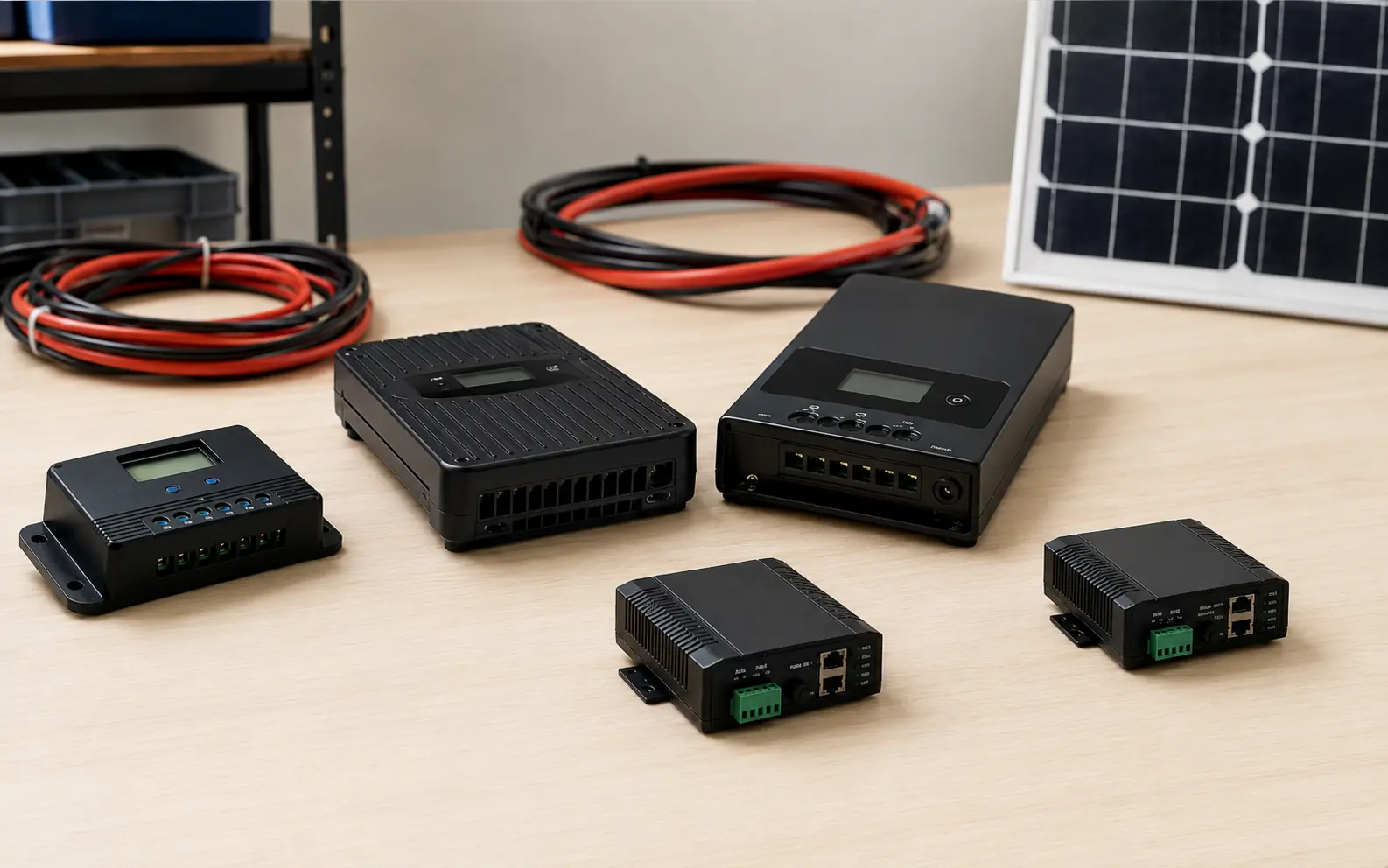
Tycon Solar® offers MPPT, PWM, and solar/PoE charge controllers for different remote-power requirements.
Start With the Electrical Requirements
Before comparing controller features, identify these six things:
- Battery-bank voltage
- Battery chemistry and required charge profile
- Maximum solar-array open-circuit voltage (Voc)
- Solar-array wattage and required charging current
- Load-output requirements
- Monitoring, communications, and grounding requirements
PWM vs. MPPT Solar Charge Controllers
The two most common controller technologies are PWM, or Pulse Width Modulation, and MPPT, or Maximum Power Point Tracking. Neither should be selected solely because one technology is newer or more sophisticated. The better choice depends on the electrical design and application.
PWM Solar Charge Controllers
PWM controllers are a practical choice when the solar-array voltage is appropriately matched to the battery system and the application does not require the additional voltage-conversion flexibility of MPPT.
They are commonly used in compact 12V and 24V remote power systems where simplicity, low self-consumption, and cost are important.
MPPT Solar Charge Controllers
MPPT controllers continuously track the solar array's operating point and convert available panel power into the voltage and current required for battery charging.
MPPT can be especially useful when the solar-array operating voltage is substantially higher than battery voltage, when larger arrays are used, or when system designers need more flexibility in panel configuration and wiring.
1. Match the Controller to the Battery-Bank Voltage
Start with the nominal battery-bank voltage. Remote solar systems commonly use 12V, 24V, or 48V battery configurations, although controller capabilities vary by model.
Confirm that the controller explicitly supports the battery voltage you intend to use. Some controllers automatically detect supported battery voltages, while others are designed for a specific system architecture.
2. Verify Battery Chemistry and Charging Requirements
AGM, GEL, flooded lead-acid, lithium, and LiFePO4 batteries do not necessarily use the same charging voltages or charging sequence. The controller's available battery profiles must be compatible with the battery manufacturer's requirements.
Lithium compatibility deserves particular attention. A controller may offer a lithium charging mode while still not being compatible with every battery-management system (BMS). Always verify the controller settings and battery requirements together before deployment.
Browse Tycon Solar® batteries when matching storage and charging components for a remote power system.
3. Check Maximum Solar Input Voltage
One of the most important controller limits is maximum PV input voltage. The combined open-circuit voltage (Voc) of the solar array must remain below the controller's published maximum input rating.
This calculation should use the array's expected cold-weather Voc, not just the panel's rated Voc at standard test conditions. Solar-panel voltage increases as temperature falls, so an array that appears acceptable at 25°C may exceed a controller's voltage limit during very cold weather.
When panels are wired in series, their voltages add. When they are wired in parallel, current increases instead. Both values must remain within the controller and wiring limits.
4. Match Solar-Array Power and Charging Current
Charge controllers also have a maximum battery-charging current and, for many models, a published maximum recommended solar-array wattage for each supported battery voltage.
Dividing array wattage by battery voltage can provide a rough first estimate of charging current, but it should not be used as the final controller-selection method. Battery charging voltage is higher than nominal battery voltage, operating conditions vary, and controller manufacturers specify their own allowable PV power and current limits.
The final design should remain within the controller's published maximum PV voltage, maximum solar power, charge-current rating, and other model-specific limits.
Size the Complete Power System, Not Just the Controller
Solar-array size, battery capacity, equipment load, available sunlight, and required autonomy all affect the controller selection. Tycon Systems® provides power and solar sizing tools to help establish the initial system requirements.
Use the Power & Solar Calculators →5. Consider Load Control
Many solar charge controllers include a controlled load output. This can be useful for powering cameras, radios, sensors, lighting, and other DC equipment directly from the battery system.
When using the controller's load terminals, confirm the maximum continuous load current and understand the available operating modes. Some controllers provide low-voltage disconnect, manual control, lighting schedules, or other load-management functions.
Loads that exceed the controller's output rating may need to be powered through separate switching or distribution hardware rather than directly through the controller.
6. Check Grounding Requirements
Grounding architecture can be important in telecommunications, industrial, and network-power installations. Verify whether the system requires negative-ground, positive-ground, or isolated operation and select equipment that is compatible with that requirement. Do not assume all solar charge controllers use the same grounding arrangement.
7. Decide Whether Monitoring Is Important
A controller display may be sufficient for a system that is easy to access. Remote infrastructure can benefit from additional communications and monitoring because technicians may otherwise need to visit the site simply to determine battery, charging, or load conditions.
Depending on the controller model, available interfaces can include local displays, Bluetooth, serial communications, or integration with external remote-monitoring equipment.
Solar Charge Controllers for Remote Power Applications
Security and Surveillance
Remote cameras, wireless bridges, cellular routers, and network equipment can operate continuously, making reliable battery charging and low-voltage load protection important considerations.
Wireless and Telecom Equipment
Radios, access points, repeaters, gateways, and other communications devices may require specific DC or PoE output voltages in addition to solar charging. Integrated solar/PoE controller designs can simplify some of these deployments.
Industrial Monitoring and IoT
Sensors, telemetry systems, controllers, weather stations, and industrial monitoring equipment often operate at sites where reliable charging and remote visibility can reduce unnecessary maintenance visits.
Solar Lighting and Other DC Loads
Controllers with programmable load outputs can support lighting and other equipment that needs scheduled, dusk-to-dawn, or low-voltage-controlled operation.
Common Solar Charge Controller Selection Mistakes
- Checking only wattage: Solar-array voltage, charge current, and battery configuration matter as much as total panel watts.
- Ignoring cold-weather Voc: Low temperatures can raise panel voltage above the value shown at standard test conditions.
- Assuming every lithium battery is compatible: Verify the charging profile and BMS requirements for the specific battery.
- Assuming MPPT is always necessary: PWM can be a practical solution for appropriately matched compact systems.
- Ignoring the load-output rating: The controller may be capable of charging the battery bank but unable to directly switch the entire equipment load.
- Overlooking monitoring and grounding: These requirements can be important in remote, industrial, and communications installations.
Need More Than a Standalone Charge Controller?
When the project requires solar generation, battery storage, charge control, enclosure, and mounting to work as one system, RemotePro® off-grid solar power systems provide complete configurations for cameras, wireless equipment, sensors, communications, and other remote electronics.
Explore RemotePro® →Solar Charge Controller FAQs
How do I know what size solar charge controller I need?
Match the controller to the battery-bank voltage, battery chemistry, maximum solar-array Voc, solar wattage, required charging current, and load requirements. Always confirm the final configuration against the controller's published specifications.
Is MPPT always better than PWM?
No. MPPT provides useful voltage-conversion and solar-array design flexibility and can improve energy utilization in many systems. PWM remains a practical solution for smaller systems where panel and battery voltages are appropriately matched.
Can I connect any solar-panel voltage to an MPPT controller?
No. The array's maximum cold-weather open-circuit voltage must remain below the controller's maximum PV input rating. Exceeding that limit can damage the controller.
Can I use a solar charge controller with LiFePO4 batteries?
Many controllers support lithium charging profiles, but compatibility should be verified for the specific battery and BMS. The controller's charging parameters must match the battery manufacturer's requirements.
Does a charge controller protect the battery from excessive discharge?
Some controllers provide a controlled load output with low-voltage disconnect. That protection applies to loads connected through the controller's load-control circuitry and is subject to its current rating. Battery systems may also include separate BMS or load-protection functions.
Do I need remote monitoring?
Not necessarily. Local monitoring may be sufficient for accessible installations. For remote infrastructure, communications and monitoring can be valuable because they provide information about charging, battery, and load conditions without requiring an immediate site visit.
Start With the System Requirements
If you're matching solar panels, batteries, charge control, equipment load, and site conditions, Tycon Systems® can help determine the appropriate remote-power configuration for your project.
Request a System Design → Browse Charge Controllers