





When the Sun Returns but the Battery Can't Charge: The Cold-Weather LiFePO4 Challenge
When the Sun Returns but the Battery Can't Charge: The Cold-Weather LiFePO4 Challenge
Imagine a remote monitoring station installed along a mountain highway. It is the middle of winter, temperatures have fallen well below freezing, and the equipment has been operating from battery power throughout the night.
Then the sun rises. The solar panel begins producing energy again, and the battery needs to recharge before another long winter night.
There is just one problem: a conventional lithium battery may be too cold to safely accept a charge.
Why Cold-Weather LiFePO4 Charging Is Different
Lithium iron phosphate, or LiFePO4, offers several advantages for remote power systems, including high cycle life, relatively low weight and substantial usable energy compared with traditional lead-acid batteries.
But low-temperature charging creates a significant engineering challenge.
Most conventional LiFePO4 batteries should not be charged below 0°C (32°F) unless the battery incorporates an appropriate low-temperature charging strategy or heating system. Low-temperature charging of lithium-ion cells can promote undesirable lithium plating at the negative electrode, which can damage the cell and reduce its useful life.
For additional technical background, peer-reviewed battery research continues to examine lithium plating and performance degradation during sub-zero lithium-ion charging .
Available Sunlight Is Only Useful If the Battery Can Accept the Charge
An off-grid system can have a functioning solar panel and still lose energy balance if the battery cannot recharge during the available daylight window. In winter, when days are already shorter, delaying charging until the battery warms can become an important system-design constraint.
A LiFePO4 Battery That Can Charge at -30°C (-22°F)
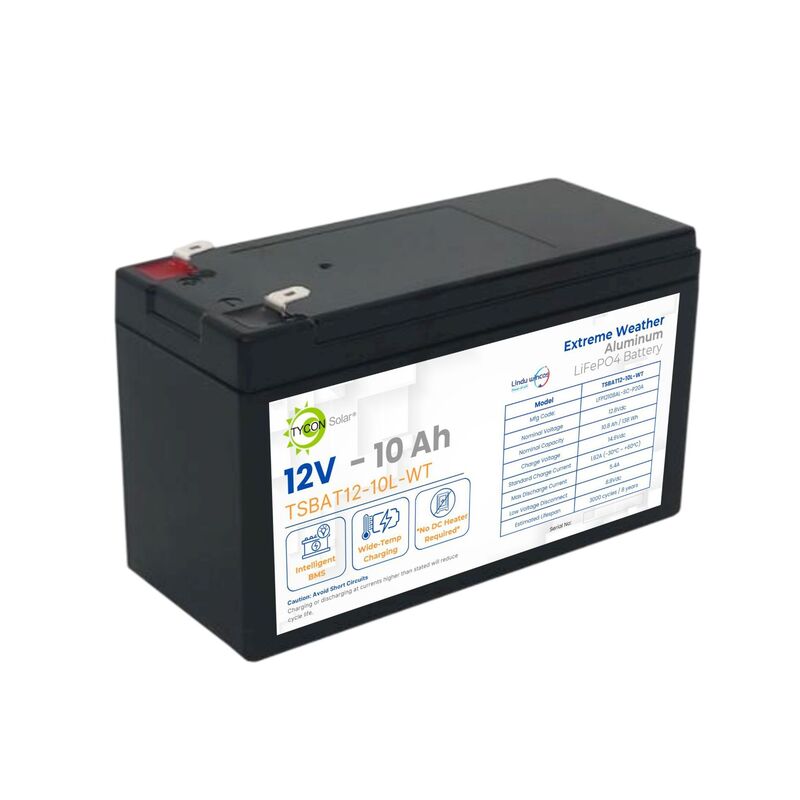
The Tycon Solar® TSBAT12-10L-WT wide-temperature LiFePO4 battery was designed specifically to address this problem.
Tycon® uses a specialized wide-temperature aluminum-anode design that allows this 12V lithium battery to accept a charge at temperatures as low as -30°C (-22°F) without requiring an external battery heater.
Its specified operating temperature ranges are:
- Charging: -30°C to +60°C (-22°F to +140°F)
- Discharging: -40°C to +70°C (-40°F to +158°F)
An integrated Battery Management System, or BMS, provides charge and discharge protection while the LiFePO4 chemistry provides the long-cycle-life characteristics expected from modern lithium battery storage.
Cold-Weather Charging Does Not Mean Full-Rate Charging
This is one of the most important specifications to understand.
The ability to charge at -30°C does not mean the battery accepts the same charging current at every temperature.
-30°C to +5°C:
Maximum charging current: 1.62A
+5°C to +60°C:
Maximum charging current: 5.4A
This temperature-dependent current limit should be considered when sizing the solar charge controller and evaluating winter battery-recovery time.
A cold battery can begin accepting solar energy instead of waiting for an external heater to raise its temperature, but charging remains intentionally limited until conditions become warmer.
Low-Temperature Capability Changes the Charging Window, Not the Laws of Energy Balance
The battery still needs enough available solar energy and enough time to replace what the equipment consumed overnight. Reduced charging current at very low temperature can extend recovery time and should be included in winter system design.
Why This Matters for Equipment That Runs 24/7
Remote electronics do not stop consuming energy simply because the temperature drops.
Winter installations may still need to operate:
- Security cameras
- Wireless radios
- Cellular routers
- Environmental sensors
- Industrial monitoring equipment
- Telemetry systems
- Remote controllers
- Low-power lighting and backup equipment
The battery supplies that equipment when solar generation is unavailable. When daylight returns, the system needs to replace the energy that was removed overnight.
Short winter days, storms, snow, cloud cover and low temperatures can all make that energy balance more difficult.
Eliminating an External Battery Heater Can Reduce One Winter Load
One common strategy for charging conventional lithium batteries in freezing weather is to warm the battery before allowing charging to begin.
That can be effective, but a battery heater becomes another electrical load that the solar array and battery system need to support.
The amount of energy consumed by a heater depends on its wattage, operating time, insulation, ambient temperature and control strategy.
Because the TSBAT12-10L-WT does not require an external battery heater within its specified charging-temperature range, it can remove that additional heating load from appropriately designed systems.
Winter Solar Design Still Needs Enough Energy
Wide-temperature battery performance does not eliminate the need to properly size the solar array and battery capacity.
A cold-weather off-grid design should still consider:
- Complete equipment wattage
- Daily operating hours
- Winter peak-sun-hours
- Battery autonomy
- Temperature-dependent battery behavior
- Reduced low-temperature charging current
- Snow or seasonal shading
- Controller and conversion losses
- Required system reserve
The Tycon Systems® power and solar calculators can help estimate equipment energy requirements when planning a remote installation.
How Much Energy Does This 12V 10Ah Battery Store?
The TSBAT12-10L-WT has a specified nominal voltage of 12.8V and nominal capacity of 10.8Ah, providing approximately 138Wh of nominal stored energy.
Consider a low-power monitoring device that continuously consumes 3W:
3W × 24 Hours = 72Wh per Day
That does not mean a 138Wh battery automatically provides a specific number of days of runtime.
Actual runtime depends on usable depth of discharge, battery temperature, equipment startup behavior, conversion losses, other connected loads, battery condition and how much solar energy is available to recharge the system.
A Long-Cycle Alternative to Small Lead-Acid Batteries
Small remote power systems have traditionally used sealed lead-acid batteries because they are familiar, widely available and relatively inexpensive.
Tycon® designed the TSBAT12-10L-WT as a same-size replacement for comparable lead-acid batteries, while providing several published advantages.
Cycle life:
Rated for more than 4,000 cycles at 80% depth of discharge.
Usable energy:
Tycon® specifies nearly twice the usable energy of a comparably rated lead-acid battery under its stated comparison conditions.
Weight:
Approximately 2.6 lb (1.2 kg), about 40% less than the comparable lead-acid battery referenced by Tycon®.
Integrated BMS:
Battery-management electronics provide charging and discharging protection inside the battery.
For remote equipment, longer battery life can have value beyond the cost of the battery itself. Replacement may involve travel, labor, tower access, site scheduling or opening secured outdoor equipment enclosures.
Is It Really a Drop-In Lead-Acid Replacement?
Mechanically, the TSBAT12-10L-WT is designed around the familiar small lead-acid battery form factor and uses F2 spade terminals.
Electrically, compatibility should still be verified before replacing an existing battery.
Check:
- Charging voltage
- Maximum charging current
- Low-temperature charging current
- System discharge current
- Terminal type and polarity
- Physical dimensions
- Connected equipment requirements
The specified charging voltage for the TSBAT12-10L-WT is 14.6V ±0.2V.
Review the TSBAT12-10L-WT technical datasheet before installing the battery into an existing charging system.
Built for Small Remote and Outdoor Power Systems
The battery measures approximately 5.95 × 2.56 × 3.9 inches (151 × 65 × 99 mm) and carries an IP65 weatherproofing specification.
Up to four batteries can be connected in series or parallel, subject to Tycon® electrical and installation requirements.
Potential applications include:
- Remote wireless equipment
- Environmental monitoring stations
- Outdoor security systems
- Industrial sensors
- Compact off-grid solar systems
- Small outdoor lighting applications
- UPS and DC backup systems
An IP65 battery rating does not remove the need to evaluate the rest of the installation. Connectors, controllers, wiring, network equipment and other electronics still need appropriate outdoor protection.
Battery Capacity Is Only Half the Question
For a winter solar installation, ask both how much energy the battery stores and whether it can accept enough charging energy during the temperatures and daylight conditions the site will actually experience.
Where Does This Fit Into a Complete Remote Solar System?
The battery is only one component in the power architecture.
A complete off-grid installation also needs properly sized solar generation, charge control, wiring, outdoor protection and the correct electrical output for the equipment being powered.
For fixed sites without utility power, RemotePro® systems combine these components into complete off-grid solar power configurations for cameras, wireless equipment, sensors, monitoring systems and other remote electronics.
Cold-Weather LiFePO4 Battery FAQs
Can LiFePO4 batteries charge below freezing?
Many conventional LiFePO4 batteries should not be charged below 0°C (32°F) unless they use an appropriate heating or low-temperature charging system. The TSBAT12-10L-WT uses a specialized wide-temperature design rated for charging down to -30°C (-22°F).
Does the TSBAT12-10L-WT need a battery heater?
It does not require an external heater to charge within its specified -30°C to +60°C charging-temperature range. Other components in the installation may still have their own temperature requirements.
Can it charge at full current at -30°C?
No. Maximum charging current is 1.62A from -30°C to +5°C and 5.4A from +5°C to +60°C. The reduced cold-weather current limit should be included when evaluating battery recovery time.
How much energy does the battery store?
The specified nominal voltage is 12.8V and nominal capacity is 10.8Ah, providing approximately 138Wh of nominal stored energy.
How long does the battery last?
Tycon® rates the TSBAT12-10L-WT for more than 4,000 cycles at 80% depth of discharge. Actual service life depends on charging conditions, temperature, discharge depth, operating current, storage and other application factors.
Can it replace a 12V sealed lead-acid battery?
It is designed as a same-size lithium alternative for many comparable lead-acid applications, but charging voltage, current limits, terminal configuration, physical fit and connected equipment should be verified before replacement.
Is a 10Ah battery large enough for a solar-powered camera or radio?
It can be for appropriately sized low-power equipment. The answer depends on the complete device load, hours of operation, desired battery autonomy, temperature, system losses and available solar charging.
Design the Battery Around the Environment
If you are powering cameras, wireless equipment, sensors or other electronics in freezing conditions, Tycon Systems® can help match the battery, solar array, charge controller and required runtime to the actual temperature and energy demands of the site.
Explore TSBAT12-10L-WT → Request a System Design