

Reach Higher with the New 30-Foot Mast for MobileSolarPro® Solar Trailers
Reach Higher with the New 30-Foot Mast for MobileSolarPro® Solar Trailers
Mobile power solves only part of a temporary field deployment. Cameras still need a useful viewing position. Wireless radios need a clear signal path. Antennas, lights, sensors, and communications equipment may need to rise above vehicles, fencing, containers, buildings, vegetation, or uneven terrain.
The 30-foot pneumatic mast option for MobileSolarPro® gives installers additional mounting height when an 18-foot mast does not provide enough elevation for the application. The goal is not simply to put equipment higher—it is to place equipment where it can perform effectively while maintaining a stable, serviceable mobile platform.
Why Mast Height Matters on a Mobile Solar Trailer
Temporary infrastructure often has to work around obstacles that were not part of the original plan. Construction materials move. Trucks park in new locations. Equipment stacks change. Trees, fencing, containers, buildings, and terrain can interfere with cameras and wireless links.
Additional mast height can help move mounted equipment above some of those obstructions without requiring a permanent tower or pole installation.
Common mast-mounted equipment includes:
- IP surveillance cameras
- PTZ cameras
- WiFi access points
- Point-to-point wireless radios
- Cellular or communications antennas
- Temporary lighting
- Sensors and other field electronics
Higher Is Useful When It Solves a Specific Problem
The correct mast height depends on what is mounted, what the equipment needs to see or communicate with, surrounding obstructions, wind conditions, cable requirements, and the mounting limits of the complete system. Maximum height should not automatically be the default deployment height.
Surveillance: More Elevation Can Expand the View
Cameras mounted higher can often see over vehicles, fences, stored materials, equipment, and other objects that would block a lower installation.
This can be particularly useful on construction sites, parking areas, industrial yards, events, transportation projects, and temporary security perimeters where the environment changes regularly.
But additional height does not automatically improve every surveillance objective. A higher camera may provide a broader overview while producing a steeper viewing angle or fewer pixels on a specific distant subject. Camera resolution, lens selection, optical zoom, mounting angle, and the required identification distance should therefore be considered together with mast height.
Wireless: Elevation Can Help Establish Better Line-of-Sight
Wireless links can benefit significantly when antennas are moved above nearby obstructions.
Point-to-point and point-to-multipoint systems perform best when the RF path between antennas has appropriate clearance. Raising a radio can help clear vehicles, containers, structures, terrain, or vegetation that interfere with that path.
Mast height alone cannot guarantee a good wireless link. Frequency, distance, antenna gain and pattern, Fresnel-zone clearance, interference, cable loss, radio configuration, and the remote-end antenna height all affect performance.
Look Beyond Simple Visual Line-of-Sight
Being able to see the other antenna is a useful starting point, but a reliable radio link can also require clearance around the direct signal path. Raising the mast can help, but the complete wireless path should still be evaluated before deployment.
Temporary Lighting Can Benefit From Additional Height Too
Elevating a light can increase the area reached by the fixture and reduce some nearby obstructions, which can be useful for construction, emergency operations, maintenance, events, and temporary work areas.
However, a higher mounting point does not mean the same fixture will automatically provide better illumination everywhere. Light output, beam pattern, fixture angle, mounting height, required ground-level illumination, and the electrical load all need to be considered.
Because lighting can also be a relatively large electrical load, its energy consumption should be included when sizing the MobileSolarPro® battery and solar configuration.
The RPMS-MAST-30: A 30-Foot Pneumatic Mast
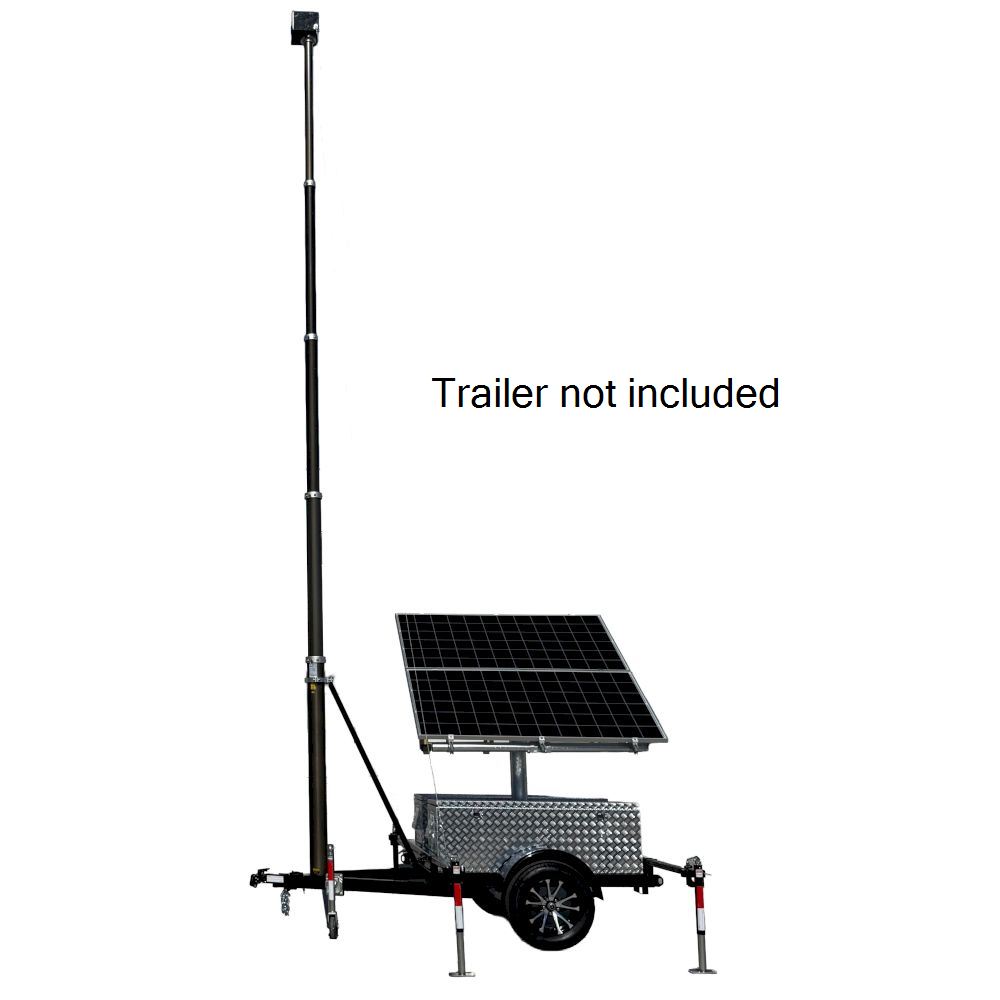
The current Tycon Systems® RPMS-MAST-30 is a pneumatic locking aluminum extension mast designed for cameras, WiFi antennas, lighting, communications equipment, and other elevated field hardware.
Current product features include:
- Approximately 30-foot maximum deployed height
- Up to 50 kg / 110 lb vertical payload
- Locking capability at different mast heights
- Two internally routed CAT6 cables
- Six internally routed 1.5 mm² power conductors
- Water-drain provision
- 12V air compressor
- Air hose, regulator and pressure gauge
- Mast extension and mounting hardware
- Guy lines for additional support while deployed
Internal Cabling Matters on a 30-Foot Mast
Getting equipment physically to the top of the mast is only part of the installation. Cameras, radios, lights, and sensors also need power and, in many cases, data connectivity.
The RPMS-MAST-30 includes two internally routed CAT6 cables and six 1.5 mm² conductors. Routing these connections inside the mast helps organize the installation and reduces the need to attach long exposed cable runs along the outside of the telescoping sections.
The available cabling still needs to be matched to the connected equipment's voltage, current, Ethernet speed, PoE requirements, and connector arrangement.
Payload Is More Than Equipment Weight
The current mast is rated for up to a 110 lb vertical payload, but simply remaining below that weight does not answer every mounting question.
Equipment at the top of a mast can include:
- Cameras
- Mounting brackets
- Wireless radios
- Antennas
- Junction enclosures
- Lighting fixtures
- Associated hardware and cabling
Physical size and wind exposure can matter in addition to static weight. Large antennas, panels, lights, or brackets can present substantial surface area to the wind even when their weight is modest.
Wind and Stability Become More Important as Height Increases
Raising equipment farther above the ground increases leverage on the mast and its supporting structure. That makes proper deployment and stabilization especially important.
The RPMS-MAST-30 includes guy lines for additional support. Operators should follow the mast documentation for setup, payload, pneumatic operation, securing the mast, and lowering procedures.
Site conditions should always be evaluated before raising the mast. High wind, unstable terrain, insufficient clearance, nearby overhead hazards, or an unsuitable equipment load may require operating at a lower height or postponing deployment.
Use Only as Much Height as the Application Needs
A 30-foot mast provides additional capability, not a requirement to operate at full extension. If the camera view, wireless path, or lighting requirement is satisfied at a lower locked position, the lower deployment may be the more appropriate configuration.
18-Foot or 30-Foot Mast?
MobileSolarPro® systems continue to support multiple mast configurations. The correct choice depends on the deployment rather than simply choosing the tallest available option.
The 18-foot configuration may be sufficient when:
- Nearby obstructions are limited
- Camera coverage is primarily close to the trailer
- The wireless path already has adequate clearance
- Additional height does not materially improve the application
The 30-foot mast becomes more attractive when:
- Cameras need to see above equipment, fencing or structures
- Wireless antennas need additional line-of-sight clearance
- Temporary infrastructure needs a higher mounting point
- Lighting needs to be positioned above a larger work area
- The same mobile platform will encounter different site conditions over time
Higher Equipment Still Has to Fit the Power Budget
Changing mast height does not change the fundamental energy equation of the trailer.
Cameras, radios, cellular routers, switches, lights, heaters, and other equipment mounted on or supported by the mast all contribute to the electrical load.
Before adding new mast-top equipment, verify that the MobileSolarPro® solar generation, battery storage, output voltage, PoE capacity, and continuous-power rating still support the complete load.
Built Into a Complete Mobile Power Platform
The mast is only one part of a MobileSolarPro® deployment.
Current trailer and skid configurations can combine:
- Solar generation
- SLA or lithium battery storage
- MPPT solar charging
- AC backup charging
- 12V, 24V and 56V power
- PoE distribution
- Remote system monitoring
- Pneumatic mast options
- Customer-supplied electronics integration
Explore MobileSolarPro® trailers and skids →
Five Questions to Answer Before Choosing 30 Feet
1. What equipment will be mounted on the mast?
2. What obstruction or coverage problem requires additional height?
3. What are the combined weight and wind characteristics of the mounted equipment?
4. What power, Ethernet and PoE connections does that equipment require?
5. What environmental and wind conditions will the deployment experience?
Applications for a 30-Foot Mobile Mast
Construction Site Surveillance
Additional height can help cameras see over fencing, stored material, containers, trucks, and changing construction activity.
Parking Lots and Equipment Yards
An elevated camera can provide a broader site overview while wireless equipment and antennas can be moved above many ground-level obstructions.
Temporary Wireless Networks
Point-to-point radios, access points, and other antennas can use additional mast height when line-of-sight is limited by local obstacles.
Emergency and Disaster Response
Mobile communications, cameras, lighting, and monitoring equipment may need elevated mounting while temporary operations are established.
Events and Temporary Facilities
Cameras, wireless infrastructure and lighting can be positioned above crowds, vehicles, temporary structures, and other activity.
Agriculture and Remote Monitoring
Cameras, antennas, sensors and communications equipment can gain additional clearance over vegetation, equipment, terrain and field infrastructure.
30-Foot Mobile Mast FAQs
How tall is the RPMS-MAST-30?
The RPMS-MAST-30 is designed to raise compatible equipment to approximately 30 feet above ground when fully deployed.
How much equipment can the mast support?
The current product is rated for up to a 50 kg, or 110 lb, vertical payload. Equipment size, mounting arrangement, wind loading and deployment conditions should also be considered rather than relying on weight alone.
Does the mast include cabling?
Yes. The current RPMS-MAST-30 includes two internally routed CAT6 cables and six 1.5 mm² power conductors for compatible mast-mounted equipment.
Does the mast have to be deployed to the full 30 feet?
No. The mast has locking collars that allow it to be secured at different operating heights, allowing the deployment height to be selected around the application.
Are guy lines included?
Yes. The current RPMS-MAST-30 includes guy lines for additional support when the mast is deployed.
Will a 30-foot mast improve wireless range?
It can improve a wireless link when added height provides better line-of-sight or Fresnel-zone clearance. Actual range and performance still depend on the radios, antennas, frequency, interference, terrain, distance, and remote-end installation.
Will mounting a camera higher improve surveillance?
Additional height can provide a broader view and help see over obstructions, but the optimal height also depends on camera resolution, lens, angle, required identification distance, and the specific surveillance objective.
Can Tycon Systems® configure MobileSolarPro® around my mast equipment?
Yes. MobileSolarPro® systems can be configured around cameras, radios, routers, sensors, lighting and other customer equipment when the electrical load, mounting, cabling and environmental requirements are compatible with the selected platform.
Start With What Needs to Go on the Mast
Tycon Systems® can help match cameras, wireless radios, antennas, lighting, power requirements, battery capacity, solar generation and mast height to a MobileSolarPro® trailer or skid.
View the 30-Foot Mast → Request a System Design