World UFO Day 2026: Remote Observation Power | Tycon®
World UFO Day, commonly observed on July 2, celebrates a subject that has fascinated people for generations: unexplained observations in the sky.
Today, the scientific conversation increasingly uses the term Unidentified Anomalous Phenomena, or UAP. Whatever is eventually determined about an unusual observation, one principle is difficult to argue with: useful conclusions require useful data.
Cameras, environmental sensors, weather instruments, communications equipment and other monitoring devices are often most valuable when they can operate continuously in the locations where observations need to be made. When those locations are far from utility power, solar generation and battery storage can provide the infrastructure that keeps the equipment running.
World UFO Day: Curiosity Is Easy. Good Data Is Harder.
World UFO Day is an unofficial observance most commonly associated with July 2, although June 24 is also recognized by some groups because of aviator Kenneth Arnold's widely reported 1947 sighting.
The subject remains culturally fascinating, but modern scientific study requires more than an eyewitness account or an unusual image.
NASA's work on Unidentified Anomalous Phenomena has emphasized the importance of high-quality observations, calibrated instruments, useful metadata and systematic data collection. Without that supporting information, determining the size, distance, motion or nature of an unusual object can be extremely difficult.
That makes World UFO Day an interesting opportunity to talk about a broader engineering problem: how do you keep observation equipment collecting dependable data when the best monitoring location is far from conventional infrastructure?
A Camera Cannot Collect Data When Its Battery Is Dead
Remote observation depends on more than the sensor itself. Power, battery reserve, communications, environmental protection, time synchronization and data storage all influence whether an unusual event is captured with enough information to be useful.
Why Observation Sites Are Often Remote
Scientific and environmental monitoring equipment is frequently deployed away from convenient buildings and utility service.
A remote location may offer:
- A clearer view of the sky or horizon
- Reduced artificial lighting
- Less obstruction from buildings or vegetation
- Access to a specific environmental or geographic location
- Distance from local electrical or radio-frequency interference
- A better position for cameras, weather equipment or other sensors
Those advantages can create a new problem: the equipment may now be hundreds of feet—or many miles—from a practical power connection.
Start With the Observation Equipment Load
Before selecting a solar panel or battery, identify everything that needs electricity.
A remote observation station might include:
- Visible-light cameras
- Infrared or thermal cameras
- Environmental sensors
- Weather instruments
- Data loggers
- Cellular routers
- Wireless radios
- PoE switches or injectors
- Local computing or storage hardware
- Monitoring and control equipment
Each device contributes to the daily energy requirement. The correct solar system is based on the complete load rather than the camera or primary sensor alone.
Nighttime Observation Creates an Interesting Solar Challenge
Many sky-observation applications are most active at exactly the time solar panels are producing no energy.
That does not prevent solar from being a practical energy source. It simply makes battery storage critical.
During daylight, the solar array supplies available energy and recharges the battery bank. After sunset, the battery supplies the cameras, sensors, communications equipment and other loads.
Battery capacity therefore needs to account for nighttime energy consumption, battery chemistry, allowable depth of discharge, system losses, temperature and the number of hours or days of reserve required by the project.
Watts Tell You Power. Watt-Hours Tell You Runtime.
A 15W camera operating continuously consumes approximately:
15W × 24 Hours = 360Wh per Day
Add the router, radio, switch, sensors and any other hardware before calculating the solar and battery requirements.
Solar Generation Has to Replace the Energy Used at Night
The solar array must do more than support the equipment during daylight. It also has to replace energy removed from the battery overnight.
That calculation should consider the installation location, seasonal peak-sun-hours, shading, panel orientation, system losses and the amount of battery recovery required after each operating period.
A system designed only around favorable summer sunlight may struggle during shorter winter days, so remote observation projects expected to operate year-round should be sized around the season that actually drives the energy requirement.
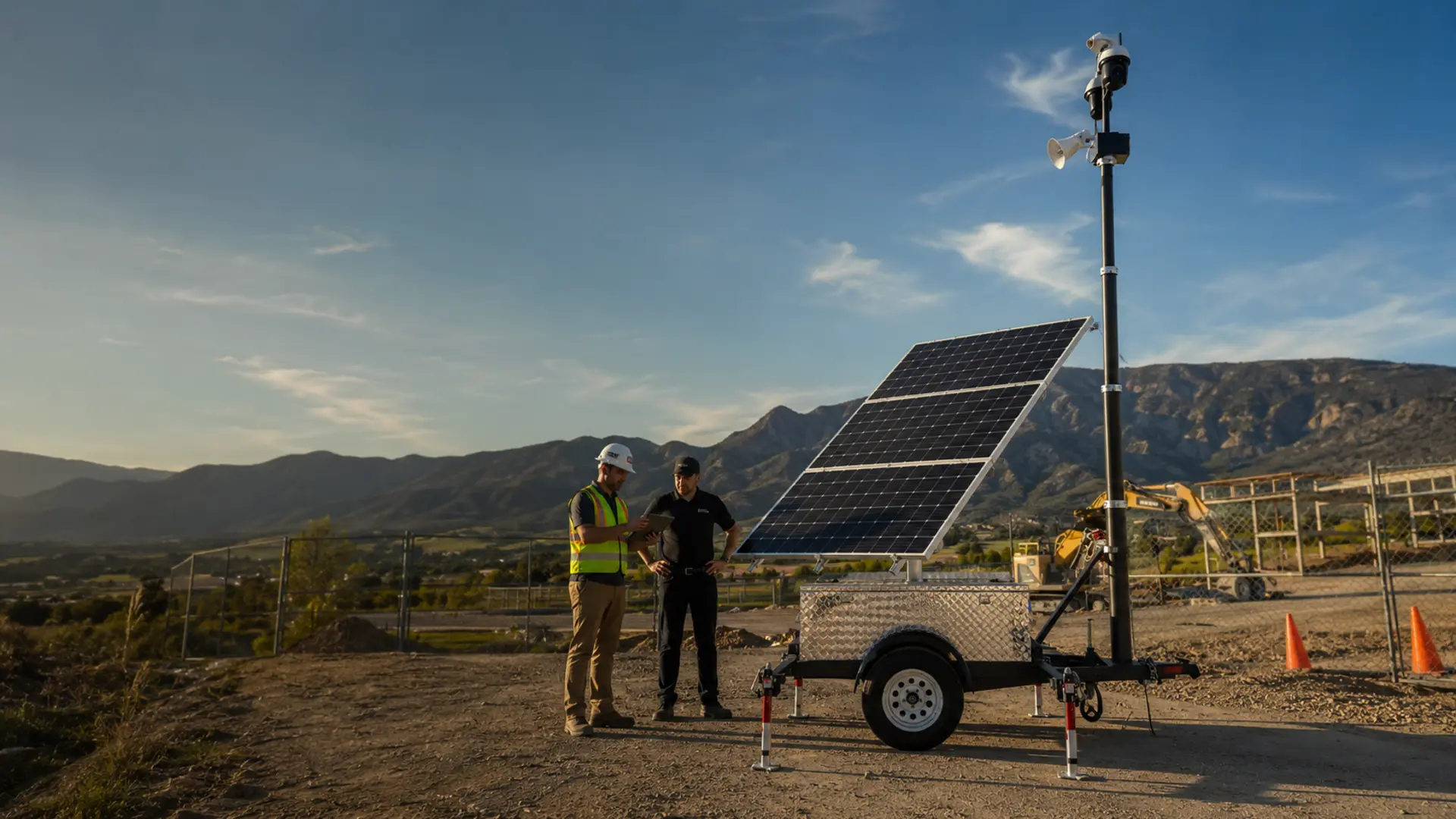
Remote Observation in the Field
Whether the objective is security, environmental research, wildlife observation, weather monitoring or simply watching the sky, the same basic infrastructure problem appears repeatedly: put the sensor where it needs to be and then provide dependable local power and connectivity.
Communications Are Part of the Energy Budget
Collecting an image is only one part of a remote monitoring system. The data may also need to be stored, transmitted or accessed remotely.
Communications might use:
- Cellular routers
- Point-to-point wireless
- WiFi
- Ethernet
- Other application-specific communications equipment
Every radio and router adds electrical load, and a failed communications link can make an otherwise functioning remote sensor appear offline.
For IP cameras and other compatible devices, Tycon Power® PoE injectors and PoE switches provide options for combining network connectivity and power delivery.
Good Observation Requires Context, Not Just an Image
One of the most important conclusions from scientific discussions of UAP is that an image without enough context may be difficult to interpret.
Useful supporting information can include:
- Accurate date and time
- Sensor location
- Camera or instrument specifications
- Exposure and image settings
- Weather conditions
- Sensor temperature
- Direction and field of view
- Corroborating measurements from another instrument
Reliable power does not make an observation scientifically meaningful by itself, but it helps keep instruments operating so those measurements can be collected consistently.
An Unidentified Observation Does Not Automatically Mean an Extraordinary One
Aircraft, balloons, satellites, drones, atmospheric effects, optical artifacts and sensor behavior can all produce unusual observations. Good instrumentation and supporting data make it easier to evaluate possible explanations before drawing conclusions.
Monitor the Power System Too
If an observation station stops recording, the problem may have nothing to do with the camera or sensor.
Useful power-system measurements can include:
- Battery voltage
- Battery charge and discharge current
- Solar-panel voltage and charging current
- Equipment load
- Temperature
- Device or relay status
Tycon® TPDIN-Monitor-WEB3 can remotely monitor four voltages, four currents and two temperatures and provides four relays for compatible monitoring and control applications.
It can also interface with compatible Tycon MPPT solar controllers to read solar, battery and load information. That makes power-system data available alongside the observation equipment rather than requiring every problem to be diagnosed through a site visit.
RemotePro® for Fixed Observation Sites
When an observation station will remain in one location and utility power is unavailable, RemotePro® is the primary Tycon Solar® family designed for that type of problem.
RemotePro® systems combine solar generation, battery storage, charge control, outdoor protection and mounting for cameras, radios, sensors and other remote field electronics.
Explore RemotePro® off-grid solar power systems →
MobileSolarPro® When the Observation Location Changes
Some observation projects are temporary, seasonal or need to move between locations.
MobileSolarPro® trailer and skid platforms combine solar charging, battery storage, field-ready outputs, mast options and the ability to integrate compatible customer-supplied cameras, radios, routers, sensors and other electronics.
This architecture can be useful for temporary monitoring, environmental projects, field research and other deployments where the power system needs to move with the instruments.
UPSPro® Solves a Different Observation Problem
If a camera, telescope controller, network device or other monitoring system already has a normal AC, DC or PoE source, off-grid solar may not be necessary.
In that case, the requirement may simply be to keep the equipment operating during a power interruption.
UPSPro® outdoor battery-backup systems are designed primarily for that use case. UPSPro® should not be described as the battery-management system inside a RemotePro® installation.
Environmental Conditions Can Affect Both Power and Data
Remote observation equipment may be exposed to heat, cold, wind, dust, moisture and lightning-related electrical events.
Those conditions can affect battery performance, solar output, communications, camera behavior and sensor accuracy.
Site design should consider:
- Equipment operating-temperature limits
- Battery chemistry and temperature behavior
- Outdoor enclosure protection
- Solar-panel and mast wind loading
- Grounding and surge protection
- Cable routing
- Access for future inspection and maintenance
Remote Observation Goes Far Beyond UAP
The engineering principles behind an off-grid sky-observation system are useful in many other applications.
Similar architectures can support:
- Wildlife cameras
- Weather stations
- Environmental sensors
- Air-quality monitoring
- Remote scientific research
- Infrastructure monitoring
- Security and surveillance
- Wireless communications
In each case, reliable observation begins with correctly sizing the power system around the instruments and the environment where they need to operate.
Eight Questions Before Building an Off-Grid Monitoring Station
1. What cameras, sensors and communications equipment need power?
2. What voltage and wattage does each device require?
3. Does the equipment operate continuously or only during certain hours?
4. How much battery autonomy is required?
5. What is the site's seasonal solar resource?
6. How will data leave the site?
7. What temperature, wind and weather conditions will the equipment experience?
8. How will the power system and observation equipment be monitored and serviced?
World UFO Day FAQs
When is World UFO Day?
World UFO Day is most commonly observed on July 2, although June 24 is also recognized by some groups. July 2 is associated with the Roswell story, while June 24 marks Kenneth Arnold's widely reported 1947 sighting.
What does UAP mean?
NASA currently uses UAP to mean Unidentified Anomalous Phenomena—observations that cannot initially be identified as known aircraft or natural phenomena based on the available information.
Has NASA found evidence that UAP are extraterrestrial spacecraft?
No. NASA states that current UAP data do not provide evidence of extraterrestrial technology and that the limited amount of high-quality observational data makes firm scientific conclusions difficult.
Can solar power operate cameras throughout the night?
Yes, when battery storage and solar generation are correctly sized. The battery supplies the load at night and the solar array replenishes that energy when sufficient sunlight is available.
Can Tycon® systems power an observatory or radar installation?
It depends on the electrical load. Tycon® systems are particularly suited to cameras, sensors, radios, routers, PoE equipment and other low-to-moderate-power field electronics. Larger telescope drives, radar systems or high-power scientific equipment should be evaluated from their actual electrical requirements before assuming a remote-power platform is suitable.
What is the difference between RemotePro® and MobileSolarPro® for observation?
RemotePro® is generally the better starting point for a fixed off-grid location. MobileSolarPro® is better suited when the cameras, sensors or communications equipment need to move between temporary observation sites.
Can I remotely monitor the solar power system?
Yes, with compatible monitoring hardware. TPDIN-Monitor-WEB3 can monitor multiple voltages, currents and temperatures and can interface with supported Tycon MPPT controllers to provide solar, battery and load information.
Start With the Cameras, Sensors and Communications Equipment
Tycon Systems® can help match the equipment load, operating hours, battery runtime, solar generation, PoE, communications and environmental requirements to a fixed or mobile remote-power system.
Request a System Design → Explore RemotePro®